Mongrelfolk: Difference between revisions
Abra Saghast (talk | contribs) m adding earlier source to infobox |
|||
| (6 intermediate revisions by 2 users not shown) | |||
| Line 1: | Line 1: | ||
{{Creature | {{Creature | ||
|name = Mongrelfolk | |name = Mongrelfolk | ||
|image = | |image = [[File:Mongrelfolk01.jpeg|250px]] | ||
[[File:Mongrelfolk01.jpeg| | |caption = Mongrelfolk depicted in ''Curse of Strahd'' (5e), p234. | ||
|caption = | |||
|alignment = Any | |alignment = Any | ||
|type = | |type = Humanoid | ||
|subtype = | |subtype = | ||
|first = | |first = ''[[Dwellers of the Forbidden City]]'' (1981), ''Monster Manual 2'' (1e) (1983) | ||
}} | }} | ||
'''Mongrelfolk''' are a creature appearing the [[Flanaess]]. | '''Mongrelfolk''' are a creature appearing in the [[Flanaess]]. | ||
==Description== | ==Description== | ||
Mongrelfolk are humanoids that have undergone, or whose ancestors underwent, horrific magical transformations, to the extent that they retain only a fraction of their original being. | Mongrelfolk are humanoids that have undergone, or whose ancestors underwent, horrific magical transformations, to the extent that they retain only a fraction of their original being.{{csb|Curse of Strahd|234}} | ||
They are a mixture of the blood of many species: humans, orcs, gnolls, ogres, dwarves, hobgoblins, elves, bugbears, bullywugs, and many others. Their appearance varies greatly. They are usually clad in dirty rags; they are ashamed of their appearance and try keep their bodies concealed, especially among strangers. | They are a mixture of the blood of many species: humans, orcs, gnolls, ogres, dwarves, hobgoblins, elves, bugbears, bullywugs, and many others. Their appearance varies greatly. They are usually clad in dirty rags; they are ashamed of their appearance and try keep their bodies concealed, especially among strangers.{{csb|Monstrous Compendium Volume Two|Mongrelman}} Each mongrelfolk’s mad combination of humanoid and animal forms results in them having a slow, awkward gait.{{csb|Curse of Strahd|234}} | ||
Free mongrelmen raise domestic game and grow fruits and vegetables. They have a long tradition of art, music, and literature. Their songs are a bizarre cacophony of animal songs mixed with mournful dirges and wails; a few sages consider them to be beautiful, but most disagree.{{csb|Monstrous Compendium Volume Two|Mongrelman}} Mongrelmen are omnivorous, but their teeth are most efficient at eating meat. The life span of a free mongrelman is between 25 and 35 years; the average slave lives only 15 to 20 years. Their infant mortality rate is very high. Their major enemies are tribes of wandering humanoids that hunt them for sport.{{csb|Monstrous Compendium Volume Two|Mongrelman}} | |||
[[File:Mongrelman05-2e_MMv2.png|thumb|250px|Mongrelman as depicted in ''Monstrous Compendium'' vol.2 (1989).]] | |||
==Personality== | ==Personality== | ||
Mongrelfolk are seldom welcome in other humanoid societies, where they are abused, enslaved, or shunned | Mongrelfolk are seldom welcome in other humanoid societies, where they are abused, enslaved, or shunned{{csb|Curse of Strahd|234}} making them to be timid and skittish outside their homes and fiercely territorial within their lairs.{{csb|Monstrous Compendium Volume Two|Mongrelman}} | ||
==Abilities== | ==Abilities== | ||
They are all masters at camouflage and mimicry to keep themselves safe and unobserved. Their ancestry also plays a | They are all masters at camouflage and mimicry to keep themselves safe and unobserved. Their ancestry also plays a role in what abilities they exhibit, some may be able to breath underwater others can see in the dark and others may even possess the ability to fly.{{csb|Curse of Strahd|234}} | ||
==Relationships== | ==Relationships== | ||
==History== | ==History== | ||
They are the victims of magical experimentation | They are the victims of magical experimentation{{csb|Curse of Strahd|234}}{{csb|Monstrous Compendium Volume Two|Mongrelman}} akin to the creation of the [[Derro]] and the [[Bredthrall]]s. | ||
==Gallery== | ==Gallery== | ||
<gallery> | |||
File:Mongrelfolk02.gif|''Monstrous Manual'' (2e), p257. Art by Jeff Butler | |||
File:Mongrelman03-1e.jpg|MM2 (1e) and ''Complete Book of Humanoids'' (2e)(1993) p45, art by Jim Holloway | |||
File:Mongrelfolk04.jpg|''Fiend Folio'' (3e) p125. Art by Matt Cavotta. | |||
</gallery> | |||
==Creative origins== | ==Creative origins== | ||
==Publication history== | ==Publication history== | ||
Mongrelfolk have proven popular throughout the editions. They have appeared in every single edition, except 4e. The fill a very particular niche in roleplaying, and they have continued to have stats written and their lore expanded in each edition, especially in 2e. The trope they are part of goes all the way back to ''Island of Lost Souls'' in 1933, ''The Island of Doctor Moreau'' both in 1977 and 1996, and the original [[wikipedia:H.G. Wells|H.G. Wells]] [[wikipedia:The_Island_of_Doctor_Moreau|novella]] of the same name. | |||
''The Complete Book of Humanoids'' extended the popularity of the mongrelfolk, giving them lore, creation tables, and codifying them to the format of the book, including their superstitions, and [other junk here from the book]. | |||
( | In 3e, the mongrelfolk weren't published until the ''Fiend Folio'' in 2003. While they weren't in the core ''Monster Manual'' or ''Monster Manual II'', their inclusion again hinted at their niche popularity. They were notably included in the [[Savage Tide]] adventure path by [[Paizo]], in ''The Lightless Depths'' by F. Wesley Schneider and [[James Sutter]] (''[[Dungeon]]'' 144, March 2007). | ||
==External links== | In 5e, the race was published yet again in ''Curse of Strahd''. Because it is a horror game, some themes are intended to be appalling. But, there was some discussion in the community about some sensitivite topics in the book. For example, the portrayal of mongrelfolk as suffering from mental illness, the barbaric conditions under which the mongrelfolk are kept in an abusive asylum, and the portrayal of mixed-race individuals because the word ‘mongrel’ has been used as a hateful epithet for people of mixed race or ancestry. | ||
== External links == | |||
{{External link disclaimer}} | |||
==References== | ==References== | ||
| Line 46: | Line 54: | ||
<references /> | <references /> | ||
===Bibliography=== | ===Bibliography=== | ||
* Author unknown. MC2 ''Monstrous Compendium Volume Two''. Lake Geneva, WI: TSR, 1989. Item code TSR2103. | |||
* [[Eric Cagle|Cagle, Eric]], [[Jesse Decker]], [[James Jacobs]], [[Erik Mona]], [[Matt Sernett]] and [[]]. ''Fiend Folio''. Renton, WA: Wizards of the Coast, 2003. Item code 88661. | |||
* {{BibliographyMagazine|magazine=Dragon|issue=242|article=|firstname=Jonathan M.|lastname=Richards|date=Dec 1997}} | |||
* [[Bill Slavicsek|Slavicsek, Bill]]. ''The Complete Book of Humanoids''. Renton, WA: TSR, 1999. Item code TSR2135. | |||
* [[Christopher Perkins|Perkins, Christopher]]. ''Curse of Strahd''. Renton, WA: Wizards of the Coast, 2016. Item code B6517. | |||
{{index}} | {{index}} | ||
[[Category:Creatures]] | [[Category:Creatures]] | ||
[[Category:Humanoids]] | |||
[[Category:Races]] | |||
Latest revision as of 07:05, 13 November 2024
| Mongrelfolk | |
|---|---|
 Mongrelfolk depicted in Curse of Strahd (5e), p234. | |
| General information | |
| Alignment: | Any |
| Type: | Humanoid |
| First appearance: | Dwellers of the Forbidden City (1981), Monster Manual 2 (1e) (1983) |
Mongrelfolk are a creature appearing in the Flanaess.
Description
Mongrelfolk are humanoids that have undergone, or whose ancestors underwent, horrific magical transformations, to the extent that they retain only a fraction of their original being.[1] They are a mixture of the blood of many species: humans, orcs, gnolls, ogres, dwarves, hobgoblins, elves, bugbears, bullywugs, and many others. Their appearance varies greatly. They are usually clad in dirty rags; they are ashamed of their appearance and try keep their bodies concealed, especially among strangers.[2] Each mongrelfolk’s mad combination of humanoid and animal forms results in them having a slow, awkward gait.[1]
Free mongrelmen raise domestic game and grow fruits and vegetables. They have a long tradition of art, music, and literature. Their songs are a bizarre cacophony of animal songs mixed with mournful dirges and wails; a few sages consider them to be beautiful, but most disagree.[2] Mongrelmen are omnivorous, but their teeth are most efficient at eating meat. The life span of a free mongrelman is between 25 and 35 years; the average slave lives only 15 to 20 years. Their infant mortality rate is very high. Their major enemies are tribes of wandering humanoids that hunt them for sport.[2]

Personality
Mongrelfolk are seldom welcome in other humanoid societies, where they are abused, enslaved, or shunned[1] making them to be timid and skittish outside their homes and fiercely territorial within their lairs.[2]
Abilities
They are all masters at camouflage and mimicry to keep themselves safe and unobserved. Their ancestry also plays a role in what abilities they exhibit, some may be able to breath underwater others can see in the dark and others may even possess the ability to fly.[1]
Relationships
History
They are the victims of magical experimentation[1][2] akin to the creation of the Derro and the Bredthralls.
Gallery
-
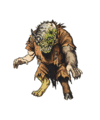 Monstrous Manual (2e), p257. Art by Jeff Butler
 -
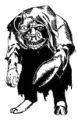 MM2 (1e) and Complete Book of Humanoids (2e)(1993) p45, art by Jim Holloway
 -
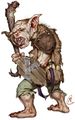 Fiend Folio (3e) p125. Art by Matt Cavotta.


Creative origins
Publication history
Mongrelfolk have proven popular throughout the editions. They have appeared in every single edition, except 4e. The fill a very particular niche in roleplaying, and they have continued to have stats written and their lore expanded in each edition, especially in 2e. The trope they are part of goes all the way back to Island of Lost Souls in 1933, The Island of Doctor Moreau both in 1977 and 1996, and the original H.G. Wells novella of the same name.
The Complete Book of Humanoids extended the popularity of the mongrelfolk, giving them lore, creation tables, and codifying them to the format of the book, including their superstitions, and [other junk here from the book].
In 3e, the mongrelfolk weren't published until the Fiend Folio in 2003. While they weren't in the core Monster Manual or Monster Manual II, their inclusion again hinted at their niche popularity. They were notably included in the Savage Tide adventure path by Paizo, in The Lightless Depths by F. Wesley Schneider and James Sutter (Dungeon 144, March 2007).
In 5e, the race was published yet again in Curse of Strahd. Because it is a horror game, some themes are intended to be appalling. But, there was some discussion in the community about some sensitivite topics in the book. For example, the portrayal of mongrelfolk as suffering from mental illness, the barbaric conditions under which the mongrelfolk are kept in an abusive asylum, and the portrayal of mixed-race individuals because the word ‘mongrel’ has been used as a hateful epithet for people of mixed race or ancestry.
External links
Disclaimer:Any lore presented through the following links does not necessarily adhere to established officially published content, and the views expressed do not necessarily represent the views of the editors of this wiki.
References
Citations
Bibliography
- Author unknown. MC2 Monstrous Compendium Volume Two. Lake Geneva, WI: TSR, 1989. Item code TSR2103.
- Cagle, Eric, Jesse Decker, James Jacobs, Erik Mona, Matt Sernett and [[]]. Fiend Folio. Renton, WA: Wizards of the Coast, 2003. Item code 88661.
- Richards, Jonathan M.. Dragon #242. Renton, WA: Wizards of the Coast, Dec 1997.
- Slavicsek, Bill. The Complete Book of Humanoids. Renton, WA: TSR, 1999. Item code TSR2135.
- Perkins, Christopher. Curse of Strahd. Renton, WA: Wizards of the Coast, 2016. Item code B6517.
Encyclopedia Greyhawkania Index
The Encyclopedia Greyhawkania Index (EGI) is based on previous work of Jason Zavoda through '08, continued by numerous other fans. The EGI article has a list of sources, product names, abbreviations, and a link to the full, downloadable index.
| Topic | Type | Description | Product | Page/Card/Image
|
|---|---|---|---|---|
| Mongrelman {Mongrelfolk} | Monster | Curse of Strahd, D&D 5e | 17, 77, 145, 146, 147, 148, 150, 151, 152, 153, 154, 155, 156, 225, 234 | |
| Mongrelman {Mongrelfolk} | Monster | DMGR4 - Monster Mythology | 56 | |
| Mongrelman {Mongrelfolk} | Monster | Dragon magazine #242 | 86-94 | |
| Mongrelman {Mongrelfolk} | Monster | Dragon magazine #359 | 97 | |
| Mongrelman {Mongrelfolk} | Monster | Fiend Folio, D&D 3.0 | 125, 126 | |
| Mongrelman {Mongrelfolk} | Monster | I1 Dwellers of the Forbidden City | 3, 7, 10, 11, 12, 15, 18, 19, 20, 25 | |
| Mongrelman {Mongrelfolk} | Monster | MC2 - Monstrous Compendium Volume 2 | Insert (Mongrelman) | |
| Mongrelman {Mongrelfolk} | Monster | MC5 Monstrous Compendium Greyhawk Adventures Appendix | Encounter Tables | |
| Mongrelman {Mongrelfolk} | Monster | Monstrous Manual, AD&D 2e | 257 | |
| Mongrelman {Mongrelfolk} | Monster | Monstrous Manual, AD&D 2e (Premium Edition) | 257 | |
| Mongrelman {Mongrelfolk} | Monster | Monster Manual 2, AD&D 1e | 92 | |
| Mongrelman {Mongrelfolk} | Monster | PHBR10 - The Complete Book of Humanoids | 9, 43-46, 50, 75, 76, 80, 82, 87, 88, 89, 115, 116, 117, 118, 119, 120 |