Al'Akbar: Difference between revisions
No edit summary |
Abra Saghast (talk | contribs) m Text replacement - "|↵power=" to "|rank =" |
||
| (28 intermediate revisions by 4 users not shown) | |||
| Line 1: | Line 1: | ||
{{Deity | {{Deity| | ||
image=[[Image:Cup and Talisman01.jpg]]| | |||
caption=The ''[[Cup and Talisman of Al'Akbar]]'', as depicted in ''Book of Artifacts'' (1993).| | |||
| | name=Al'Akbar||titles =High Cleric, Restorer of Righteousness| | ||
home=[[Seven Heavens]]|rank =Demigod| | |||
gender=Male| | |||
class=Cleric| | |||
alignment=Lawful Good| | |||
portfolio=Guardianship, Faithfulness, Dignity, Duty| | |||
| | domains=Community, Good, Healing, Law, Protection| | ||
alias=None| | |||
| | super=The rest of the [[Baklunish]] pantheon| | ||
| | |||
| | |||
| | |||
| | |||
| | |||
| | |||
| | |||
}} | }} | ||
'''Al'Akbar''' | '''Al'Akbar''' is the [[Baklunish]] demigod of dignity, duty, faithfulness, and guardianship. His symbol is a cup and eight-pointed star, images of the legendary ''[[Cup and Talisman of Al'Akbar|Cup and Talisman]]'' that now bear his name. | ||
==Description== | |||
Al'Akbar is a golden-skinned Baklunish man. He is lawful good. His favored weapon is the falchion. | |||
==Relationships== | |||
Al'Akbar is subordinate to the other Baklunish gods, remaining a mere demigod out of respect for them. Despite this fact, the nations of Ekbir and Tusmit seem to place him before other gods. | |||
His faithful oppose the sadistic elemental cults of [[Ull]]. | |||
Al'Akbar is allied with [[Heironeous]]. | |||
==Realm== | |||
Al'Akbar has no realm of his own. He dwells in [[Mount Celestia]]'s fifth layer, Mertion, in ''Soqed Hezi'', the City of Swords. The ruler of Soqed Hezi is the sword archon Bahram, known as the Conquering and Triumphant Fire, who answers only to the tome archon Raziel. | |||
==Dogma== | |||
Al'Akbar's priests use the Cup and Talisman as metaphors for the good life, urging their flocks to be vessels of kindness and emblems of devotion. They use Al'Akbar's relationship to his pantheon as a model for their own relationships to their superiors, urging obedience and respect for the wisdom of those of higher station. Followers of Al'Akbar are expected to be both steadfast and merciful. The priests of Al'Akbar are opposed to the slave trade. | |||
Ancient Baklunish is the [[Languages|language]] of Al'Akbar's faith. | |||
==Worshipers== | |||
Al'Akbar's faith is divided into two major sects, though smaller, more obscure sects exist among the [[Plains of the Ulakandar|Ulakandar]]. The Exalted Faith, based in [[Ekbir]], is led by Caliph [[Xargun]], while the True Faith, based in the [[Yatil Mountains]] and most popular in [[Ket]], is headed by the [[Grand Mufti of the Yatils]]. The two sects split after the ''Cup and Talisman of Al'Akbar'' was stolen from its traditional place in [[Ekbir]]. The grand mufti was held responsible and exiled, where he started a rival faith, claiming the caliph was no longer the rightful spiritual leader. | |||
The True Faith has a harsher, lawful neutral interpretation of Al'Akbar's dogma, emphasizing hard work, plain speech, and obedience, while the Exalted Faith is lawful good or neutral good, stressing rhetoric, diplomacy, and academic achievement. | |||
===Clergy=== | |||
Clerics of the Exalted Faith are known as ''qadi''. Clerics of the True Faith are called ''mullahs''. Both act as judges, ministers, scholars, teachers, healers, advisers, and guardians in their respective societies. Some are intolerant of the "infidels" who belong to non-Baklunish faiths. Wandering clerics of Al'Akbar search for the lost ''Cup and Talisman''. | |||
===Paladins=== | |||
Paladins of Al'Akbar, known as Exalted Ones, work to lead by example, demonstrating by their words and deeds that faithfulness to and guardianship of the old traditions are the only correct path to revelation. They wear billowing tunics that obscure their armor and conceal their faces. Their clothing is white or tan, often with gold or purple trim. Members of the True Faith wear only white, with no decoration. Males wear turbans, while females wear only simple white gold circlets. They oppose the forces of darkness, seek to defend Baklunish traditions and people, and search for the ''Cup and Talisman of Al'Akbar''. | |||
===Other orders=== | |||
The ''farises'' are an order of Ekbiri knights in the service of Al'Akbar. | |||
==Temples== | |||
Al'Akbar is revered primarily in [[Ekbir]], [[Ket]], the [[Plains of the Ulakandar]], [[Tusmit]], and [[Zeif]]. | |||
The Mosque of Al'Akbar, in the city of Ekbir, is a popular destination for pilgrims of the Exalted Faith. | |||
==Rituals== | |||
A ceremony known as the Procession of Blessing used to be performed using the ''Cup and Talisman of Al'Akbar'', but this ended when the relics were stolen by elven raiders in 219 CY. | |||
Ritual prayers may be made at dawn or dusk. | |||
==Artifacts== | |||
Al'Akbar is associated with the ''[[Cup and Talisman of Al'Akbar|Cup and Talisman]]'' named for him. | |||
==History== | |||
Al'Akbar was the most exalted high priest in what are now the lands of the [[Plains of the Ulakandar|Ulakandar]]. After the [[Invoked Devastation]], during that time of misery and suffering, he was given the ''Cup and Talisman'' by [[Pelor|Al'Asran]] to help heal his people's ills and return them to the traditional Baklunish faith. | |||
Al'Akbar founded the city of Ekbir and, for the last decade of his mortal life, ruled the nation of Ekbir as the first of its caliphs. Eventually he had a mosque to himself built and allowed his followers to call on his name in their prayers. Soon after, he ascended to the heavens to take his place among the gods. | |||
==Creative origins== | |||
The ''Cup and Talisman of Al'Akbar'' were created by Neal Healey for ''The Strategic Review'' #7, where they were associated with Allah. | |||
Al'Akbar was the | ==Publishing history== | ||
It was previously unclear if Al'Akbar was the name of the priest who received the ''Cup and Talisman'', or the god who granted it, until 1998 when the ''[[Player's Guide]]'' clarified "Al'Akbar" as the name of the priest, which agrees with ''[[The Day of Al'akbar]]''. It also established for the first time that he is a [[Baklunish]] demigod. | |||
The ''Book of Artifacts'' (1993) suggests "[[Pelor]] would be appropriate"{{csb|BoA|30}} as the god who granted the artifacts. Early ''[[Oerth Journal]]s'' used "Al'Akbar" as Pelor's Baklunish name. But, [[Gary Holian]]'s 2003 "Paladins of Greyhawk" article introduced the name Al'Asran, described as "a being bathed in sunlight",{{cite lgj|23|106}} as the bearer of the artifacts who bestowed them upon Al'Akbar. Later, it would be confirmed in the fourth edition DMG2 it was Perlor, thus confirming that Al'Asran is another name for Perlor. All sources agree this happened after the [[Invoked Devastation]].{{csb|BoA|30}}{{cite lgj|23|106}}{{csb|I9|20}}{{csb|DMG24e|152}} | |||
Al'Akbar | |||
The 1986 adventure ''[[Day of Al'Akbar]]'' is not directly connected with Greyhawk, though it explicitly discusses Al'akbar. It takes place in a desert kingdom called [[Arir]] without mention of a particular world or setting. During third edition, the events of the adventure, if not the location, were confirmed in official material as part of the history. The ''Book of Exalted Deeds'' (2003) includes the city of Khaibar and Sultan Amhara in the history of the artifacts.{{csb|DMG24e|152}} They were also reiterated in fourth edition's the ''Dungeon Masters Guide 2'' (2009){{csb|DMG24e}} and in ''[[dragmag|Dragon]]'' #379.{{cite dragon|379|84 |Artifacts |note=Bart Carrol and Steve Winter}} | |||
Al'Akbar' | |||
[[Anna Meyer]]'s popular fan-created, expanded map of the Flanaess (''see also: [[Meyer map]]'') places the Sultanate of Arir at the eastern end of the [[Dry Steppes]], at the foot of the [[Crystalmist Mountains|Crystalmists]] and [[Sulhaut mountains]], southwest of [[Sterich]]. Although, it is somewhat modified, flipping the area east-to-west to help make it correlate to the already known geography. | |||
==Gallery== | |||
Al'Akbar | <gallery> | ||
Al'Akbar01.jpg|Holy Symbol of Al'Akbar | |||
</gallery> | |||
Al | == External Links == | ||
{{external link disclaimer}} | |||
* {{cite web|last=Braggi |title=Refitting I9 Day of Al-Akbar for Greyhawk |publisher=Canonfire! Enterprises |date= |url=http://www.canonfire.com/cf/modules.php?name=News&file=article&sid=563 |access-date=2023-0*9-18 |}} | |||
== | == References == | ||
=== Notes === | |||
<references group="note" /> | |||
=== Citations === | |||
" | <references /> | ||
=== Bibliography === | |||
*Brown, Anne. ''[[Player's Guide]]''. Renton, WA: Wizards of the Coast, 1998. | |||
*Conforti, Steven, ed. ''[[Living Greyhawk]] Official Listing of Deities for Use in the Campaign,'' version 2.0. Renton, WA: Wizards of the Coast, 2005. Available online:[http://www.wizards.com/rpga/downloads/LG_Deities.zip] | |||
*[[Cook, David]]. ''Book of Artifacts''. Lake Geneva, WI: TSR, 1993. | |||
*[[Allan Grohe|Grohe Jr., Allan T.]], and [[Erik Mona]]. "All [[Oerth]]'s Artifacts." ''[[dragmag|Dragon]]'' #299. Bellevue, WA: Paizo Publishing, 2002. | |||
*[[Gary Gygax|Gygax, Gary]]. ''Dungeon Master's Guide''. Lake Geneva, WI: TSR, 1979. | |||
*Hammack, Allen. ''Day of Al'Akbar.'' Lake Geneva, WI: TSR, 1986. | |||
*Healey, Neal. "Mighty Magic Miscellany." ''[[Dragon (magazine)|The Strategic Review]]'' #7. Lake Geneva, WI: TSR, April 1976. | |||
*Holian, Gary. "Paladins of [[Greyhawk]]." ''Dungeon'' #104. Bellevue, WA: Paizo Publishing, 2003. | |||
*[[Holian, Gary]], [[Erik Mona]], [[Sean K. Reynolds]], and [[Frederick Weining]]. ''[[Living Greyhawk Gazetteer]]''. Renton, WA: Wizards of the Coast, 2000. | |||
*McComb, Colin, and [[Wolfgang Baur]]. ''Planes of Law''. Lake Geneva, WI: TSR, 1995. | |||
* [[Christopher Perkins|Perkins, Christopher]]. ''[[Warriors of Heaven]]''. Renton, WA: TSR, 1999. Item code TSR11361. | |||
*[[Wyatt, James]], Darrin Drader, and Christopher Perkins. ''Book of Exalted Deeds.'' Renton, WA: Wizards of the Coast, 2003. | |||
{{index|title=Al%' and Topic LIKE '%Akbar}} | |||
[[Category:Baklunish deities]] | |||
[[Category:Characters of the Seven Heavens]] | |||
[[Category:Deities of law]] | |||
Latest revision as of 06:19, 28 April 2025
| Al'Akbar | |
|---|---|
 The Cup and Talisman of Al'Akbar, as depicted in Book of Artifacts (1993). | |
| Names and titles | |
| Title(s): | High Cleric, Restorer of Righteousness |
| General information | |
| Portfolio: | Guardianship, Faithfulness, Dignity, Duty |
| Home: | Seven Heavens |
| Alignment: | Lawful Good |
| Gender: | Male |
| Class: | Cleric |
| Superior: | The rest of the Baklunish pantheon |
| Rules items | |
| Domains: | Community, Good, Healing, Law, Protection |
| Divine rank: | Demigod |
Al'Akbar is the Baklunish demigod of dignity, duty, faithfulness, and guardianship. His symbol is a cup and eight-pointed star, images of the legendary Cup and Talisman that now bear his name.
Description
Al'Akbar is a golden-skinned Baklunish man. He is lawful good. His favored weapon is the falchion.
Relationships
Al'Akbar is subordinate to the other Baklunish gods, remaining a mere demigod out of respect for them. Despite this fact, the nations of Ekbir and Tusmit seem to place him before other gods.
His faithful oppose the sadistic elemental cults of Ull.
Al'Akbar is allied with Heironeous.
Realm
Al'Akbar has no realm of his own. He dwells in Mount Celestia's fifth layer, Mertion, in Soqed Hezi, the City of Swords. The ruler of Soqed Hezi is the sword archon Bahram, known as the Conquering and Triumphant Fire, who answers only to the tome archon Raziel.
Dogma
Al'Akbar's priests use the Cup and Talisman as metaphors for the good life, urging their flocks to be vessels of kindness and emblems of devotion. They use Al'Akbar's relationship to his pantheon as a model for their own relationships to their superiors, urging obedience and respect for the wisdom of those of higher station. Followers of Al'Akbar are expected to be both steadfast and merciful. The priests of Al'Akbar are opposed to the slave trade.
Ancient Baklunish is the language of Al'Akbar's faith.
Worshipers
Al'Akbar's faith is divided into two major sects, though smaller, more obscure sects exist among the Ulakandar. The Exalted Faith, based in Ekbir, is led by Caliph Xargun, while the True Faith, based in the Yatil Mountains and most popular in Ket, is headed by the Grand Mufti of the Yatils. The two sects split after the Cup and Talisman of Al'Akbar was stolen from its traditional place in Ekbir. The grand mufti was held responsible and exiled, where he started a rival faith, claiming the caliph was no longer the rightful spiritual leader.
The True Faith has a harsher, lawful neutral interpretation of Al'Akbar's dogma, emphasizing hard work, plain speech, and obedience, while the Exalted Faith is lawful good or neutral good, stressing rhetoric, diplomacy, and academic achievement.
Clergy
Clerics of the Exalted Faith are known as qadi. Clerics of the True Faith are called mullahs. Both act as judges, ministers, scholars, teachers, healers, advisers, and guardians in their respective societies. Some are intolerant of the "infidels" who belong to non-Baklunish faiths. Wandering clerics of Al'Akbar search for the lost Cup and Talisman.
Paladins
Paladins of Al'Akbar, known as Exalted Ones, work to lead by example, demonstrating by their words and deeds that faithfulness to and guardianship of the old traditions are the only correct path to revelation. They wear billowing tunics that obscure their armor and conceal their faces. Their clothing is white or tan, often with gold or purple trim. Members of the True Faith wear only white, with no decoration. Males wear turbans, while females wear only simple white gold circlets. They oppose the forces of darkness, seek to defend Baklunish traditions and people, and search for the Cup and Talisman of Al'Akbar.
Other orders
The farises are an order of Ekbiri knights in the service of Al'Akbar.
Temples
Al'Akbar is revered primarily in Ekbir, Ket, the Plains of the Ulakandar, Tusmit, and Zeif.
The Mosque of Al'Akbar, in the city of Ekbir, is a popular destination for pilgrims of the Exalted Faith.
Rituals
A ceremony known as the Procession of Blessing used to be performed using the Cup and Talisman of Al'Akbar, but this ended when the relics were stolen by elven raiders in 219 CY.
Ritual prayers may be made at dawn or dusk.
Artifacts
Al'Akbar is associated with the Cup and Talisman named for him.
History
Al'Akbar was the most exalted high priest in what are now the lands of the Ulakandar. After the Invoked Devastation, during that time of misery and suffering, he was given the Cup and Talisman by Al'Asran to help heal his people's ills and return them to the traditional Baklunish faith.
Al'Akbar founded the city of Ekbir and, for the last decade of his mortal life, ruled the nation of Ekbir as the first of its caliphs. Eventually he had a mosque to himself built and allowed his followers to call on his name in their prayers. Soon after, he ascended to the heavens to take his place among the gods.
Creative origins
The Cup and Talisman of Al'Akbar were created by Neal Healey for The Strategic Review #7, where they were associated with Allah.
Publishing history
It was previously unclear if Al'Akbar was the name of the priest who received the Cup and Talisman, or the god who granted it, until 1998 when the Player's Guide clarified "Al'Akbar" as the name of the priest, which agrees with The Day of Al'akbar. It also established for the first time that he is a Baklunish demigod.
The Book of Artifacts (1993) suggests "Pelor would be appropriate"[1] as the god who granted the artifacts. Early Oerth Journals used "Al'Akbar" as Pelor's Baklunish name. But, Gary Holian's 2003 "Paladins of Greyhawk" article introduced the name Al'Asran, described as "a being bathed in sunlight",[2] as the bearer of the artifacts who bestowed them upon Al'Akbar. Later, it would be confirmed in the fourth edition DMG2 it was Perlor, thus confirming that Al'Asran is another name for Perlor. All sources agree this happened after the Invoked Devastation.[1][2][3][4]
The 1986 adventure Day of Al'Akbar is not directly connected with Greyhawk, though it explicitly discusses Al'akbar. It takes place in a desert kingdom called Arir without mention of a particular world or setting. During third edition, the events of the adventure, if not the location, were confirmed in official material as part of the history. The Book of Exalted Deeds (2003) includes the city of Khaibar and Sultan Amhara in the history of the artifacts.[4] They were also reiterated in fourth edition's the Dungeon Masters Guide 2 (2009)[5] and in Dragon #379.[6]
Anna Meyer's popular fan-created, expanded map of the Flanaess (see also: Meyer map) places the Sultanate of Arir at the eastern end of the Dry Steppes, at the foot of the Crystalmists and Sulhaut mountains, southwest of Sterich. Although, it is somewhat modified, flipping the area east-to-west to help make it correlate to the already known geography.
Gallery
-
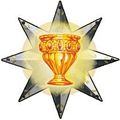 Holy Symbol of Al'Akbar

External Links
Disclaimer:Any lore presented through the following links does not necessarily adhere to established officially published content, and the views expressed do not necessarily represent the views of the editors of this wiki.
- Braggi. Refitting I9 Day of Al-Akbar for Greyhawk. Canonfire! Enterprises.
References
Notes
Citations
- ↑ a b Book of Artifacts (1993), p.30.
- ↑ a b Living Greyhawk Journal #23 (Dungeon #104/Polyhedron #163, Nov 2003), p.106.
- ↑ I9 Day of Al'Akbar (1986), p.20.
- ↑ a b Dungeon Master's Guide 2 (2009), p.152.
- ↑ Dungeon Master's Guide 2 (2009).
- ↑ "Artifacts ". Dragon #379 (Sep 2009), p.84 . Bart Carrol and Steve Winter
Bibliography
- Brown, Anne. Player's Guide. Renton, WA: Wizards of the Coast, 1998.
- Conforti, Steven, ed. Living Greyhawk Official Listing of Deities for Use in the Campaign, version 2.0. Renton, WA: Wizards of the Coast, 2005. Available online:[1]
- Cook, David. Book of Artifacts. Lake Geneva, WI: TSR, 1993.
- Grohe Jr., Allan T., and Erik Mona. "All Oerth's Artifacts." Dragon #299. Bellevue, WA: Paizo Publishing, 2002.
- Gygax, Gary. Dungeon Master's Guide. Lake Geneva, WI: TSR, 1979.
- Hammack, Allen. Day of Al'Akbar. Lake Geneva, WI: TSR, 1986.
- Healey, Neal. "Mighty Magic Miscellany." The Strategic Review #7. Lake Geneva, WI: TSR, April 1976.
- Holian, Gary. "Paladins of Greyhawk." Dungeon #104. Bellevue, WA: Paizo Publishing, 2003.
- Holian, Gary, Erik Mona, Sean K. Reynolds, and Frederick Weining. Living Greyhawk Gazetteer. Renton, WA: Wizards of the Coast, 2000.
- McComb, Colin, and Wolfgang Baur. Planes of Law. Lake Geneva, WI: TSR, 1995.
- Perkins, Christopher. Warriors of Heaven. Renton, WA: TSR, 1999. Item code TSR11361.
- Wyatt, James, Darrin Drader, and Christopher Perkins. Book of Exalted Deeds. Renton, WA: Wizards of the Coast, 2003.
Encyclopedia Greyhawkania Index
The Encyclopedia Greyhawkania Index (EGI) is based on previous work of Jason Zavoda through '08, continued by numerous other fans. The EGI article has a list of sources, product names, abbreviations, and a link to the full, downloadable index.
| Topic | Type | Description | Product | Page/Card/Image
|
|---|---|---|---|---|
| Al'Akbar {Al Akbar} | Deity | High Cleric, Restorer of Righteousness, | Bastion of Faith | 42, 87 |
| Al'Akbar {Al Akbar} | Deity | High Cleric, Restorer of Righteousness, | Dragon magazine #294 | 93 |
| Al'Akbar {Al Akbar} | Deity | High Cleric, Restorer of Righteousness, | Dragon magazine #299 | 101 |
| Al'Akbar {Al Akbar} | Deity | High Cleric, Restorer of Righteousness, | Dragon magazine #306 | 96 |
| Al'Akbar {Al Akbar} | Deity | High Cleric, Restorer of Righteousness, | Fiend Folio, AD&D 1e | 157 |
| Al'Akbar {Al Akbar} | Deity | High Cleric, Restorer of Righteousness, | Greyhawk Adventures | 89, 99 |
| Al'Akbar {Al Akbar} | Deity | High Cleric, Restorer of Righteousness, | I9 Day of Al'Akbar | |
| Al'Akbar {Al Akbar} | Deity | High Cleric, Restorer of Righteousness, | Living Greyhawk Gazetteer | 42, 43, 67, 83, 85, 115, 116, 122, 136, 164, 165, 166 |
| Al'Akbar {Al Akbar} | Deity | High Cleric, Restorer of Righteousness, | Living Greyhawk Journal #3 | 19 |
| Al'Akbar {Al Akbar} | Deity | High Cleric, Restorer of Righteousness, | Living Greyhawk Journal #4 | 28 |
| Al'Akbar {Al Akbar} | Deity | High Cleric, Restorer of Righteousness, | Living Greyhawk Journal #5 | 12 |
| Al'Akbar {Al Akbar} | Deity | High Cleric, Restorer of Righteousness, | Player's Guide to Greyhawk | 20 |
| Al'Akbar {Al Akbar} | Deity | High Cleric, Restorer of Righteousness, | Polyhedron magazine #163 | 106 |
| Al'Akbar, Cup of | Item | Artifact, | Book of Artifacts, AD&D 2e | 30, 31 |
| Al'Akbar, Cup of | Item | Artifact, | Epic Level Handbook, D&D 3.0 | 153 |
| Al'Akbar, Cup of | Item | Artifact, | Encyclopedia Magica - Volume I | 352, 353 |
| Al'Akbar, Cup of | Item | Artifact, | Polyhedron magazine #163 | 106, 107 |
| Al'Akbar, Cup of | Item | Dungeon Masters Guide 1st Edition | 124, 157 | |
| Al'Akbar, Cup of | Item | Dragon magazine #299 | 101 | |
| Al'Akbar, Cup of | Item | Greyhawk Adventures | 89, 99 | |
| Al'Akbar, Cup of | Item | I9 Day of Al'Akbar | 2, 4, 10, 13, 16, 20, 25, 26, 31, 32, 34, 35, 38 | |
| Al'Akbar, Cup of | Item | Living Greyhawk Gazetteer | 43, 165 | |
| Al'Akbar, Cup of | Item | Living Greyhawk Journal #4 | 28 | |
| Al'Akbar, Mosque of (Ekbir) | Building | Temple, | Living Greyhawk Gazetteer | 42, 43 |
| Al'Akbar, Talisman of | Item | Artifact, | Book of Artifacts, AD&D 2e | 30, 31 |
| Al'Akbar, Talisman of | Item | Artifact, | Epic Level Handbook, D&D 3.0 | 153 |
| Al'Akbar, Talisman of | Item | Artifact, | Polyhedron magazine #163 | 106, 107 |
| Al'Akbar, Talisman of | Item | Dungeon Masters Guide 1st Edition | 124, 157 | |
| Al'Akbar, Talisman of | Item | Dragon magazine #294 | 93 | |
| Al'Akbar, Talisman of | Item | Dragon magazine #299 | 101 | |
| Al'Akbar, Talisman of | Item | Greyhawk Adventures | 89, 99 | |
| Al'Akbar, Talisman of | Item | I9 Day of Al'Akbar | 2, 4, 10, 13, 16, 20, 25, 26, 31, 32, 34, 35 | |
| Al'Akbar, Talisman of | Item | Living Greyhawk Gazetteer | 43, 165 | |
| Al'Akbar, Talisman of | Item | Living Greyhawk Journal #4 | 28 | |
| Al'Akbar, Temple of (Khaibar) | Building | Temple, | I9 Day of Al'Akbar | 16, 34 |
| By the Light of the Cup and Talisman all Truth is Revealed (Al'Akbar) | Verbal communication | Philosophy/Belief, | Polyhedron magazine #163 | 106 |
| I9 Day of Al'Akbar | Adventure | Located in: Ull, | The Wonders of Ull | 38-43 |
| Invoke the Cup and Talisman (Al'Akbar) | Verbal communication | Philosophy/Belief, | Polyhedron magazine #163 | 107 |
| Paladin of Al'Akbar (Exalted One) | People Group | Religious order, | Polyhedron magazine #163 | 106, 107 |