Ravilla: Difference between revisions
Abra Saghast (talk | contribs) adding image |
Abra Saghast (talk | contribs) m →Notable NPCs: removing "D&D Miniatures" later mini not originally included in the CMG. |
||
| Line 107: | Line 107: | ||
* '''Oriana'''—Half-Dragon Mage (see image at right).<ref name=Ghostwind /> | * '''Oriana'''—Half-Dragon Mage (see image at right).<ref name=Ghostwind /> | ||
* '''Jezwyn'''—Lieutenant to Oriana, wood elf ranger.<ref name=Ghostwind /> | * '''Jezwyn'''—Lieutenant to Oriana, wood elf ranger.<ref name=Ghostwind /> | ||
===Notable Named Miniatures=== | ===Notable Named Miniatures=== | ||
Revision as of 12:38, 8 February 2023
| Empire of Ravilla | |
|---|---|
 Ravilla, as appearing in the Core Rulebook (2002) | |
| General information | |
| Other names: | Dragon Empire, Sundered Empire |
| Region: | Western Oerik |
| Government | |
| Ruler: | Grand Council of Oligarchs |
| Government: | Oligarchy |
| Alignments: | Good, presumably CG |
| Established: | 105 CY |
| Demographics | |
| Major towns: | Ventia, Xanos, |
| Races: | Grey and Wood Elves |
| Languages: | Elven |
| Groups | |
| Religions: | Seldarine |
| Allies: | None |
| Enemies: | Ahmut's Legion, Drazen's Horde, Kilsek, Thalos, Free States |
Ravilla is an elven faction in Western Oerik which is the remnants of a once enormous elven empire. Dragons and drakes are a large part of Ravillan culture.
Description
The region of Western Oerik once controlled by the "Dragon Empire" eventually fell and became known as the Sundered Empire, and the portion still ruled by elves is known as Ravilla and is a successor-state to the Dragon Empire. No longer truly an "empire", Ravilla now is the remaining grey elven city-states and the northern wood elf enclaves.[1]
Ravilla is known for many things, but perhaps most notable is that elves live in harmony with dragons in the same culture.
The art of wizardry in Ravilla dates back to before the Demon War.[2], most likely back to the time when the Dragon Empire was "elven lands" peopled by elven settlers.[3] According to Ravillan history and lore, wizardry was taught to them by the gods. The magnitude of magical lore found in Ravillan cities and which is available to elven wizards makes Ravillan wizards second to none.[1][2] There are academies for the study of wizardry with great libraries.[4]
Culture

Ravilla is fundamentally different from other elven realms on Oerth. While there are both grey and sylvan elves in the cultural alliance, their cities in the elven lands aren't up in the mountains.
Ravillan grey elves have traditions in the arts which are deeply ingrained in their culture, especially in music. Elven Warsingers are common in elven units on the battlefield, inspiring heroism and bravery.[5]
Domesticated Drakes
Main Article: Felldrake
Because Bahamut led dragons to end the Demon War c.-420 CY (1006 years after the Demon War, by Sundered Empire reckoning) and the elves vowed to defend the Abyssal Gateways, their culture was changed in an essential and deep-seated way. Bahamut and a group of elven archmages created the felldrakes to serve the elves of Ravilla.[6][7][8][9] Many, even most felldrakes are used for military purposes, but other drakes are domesticated and kept as pets,[10] while others are kept for the purposes of performing other services such as "guards, hunting companions, military animals, mounts, messengers, and even beasts of burden."[11]
Dueling Societies

After the Demon War, during years of the Elven Peace, veterans returned home from wars and formed dueling societies ostensibly dedicated to preserving their skill should the army ever have need of them again. Eventually, the societies spread to all the major cities and those who became members were highly esteemed in social circles. The dueling societies grew into highly varied specializations, each dedicating themselves to increasingly stylized, exotic weapons. When the Godwar came, the dueling societies fulfilled their originators' intent, and went to battle.
Though it is implied there are many more, known dueling societies are:
- North Wind - uses a double-bladed sword
- Snakestrike - uses a barbed whip
- Lajatang - It is stated the miniature is simply named for the weapon, and considering lore about other societies, it is likely these duelists may have had a name for their society other than the name of their chosen weapon, but there is officially no other name in lore for Chainmail Set 4. Texts explicitly do not say this is also the name of the dueling society.
There is some overlap with Bladesingers who are also known to be in Ravilla.[12] However, bladesingers are organized in "Bladesinger Guilds" rather than "Societies", but their weapons also determine their guilds and are represented by animals their weapons resemble.
History
More than 2,000 years before the Godwar, elven seafarers crossed the Solnor Ocean and settled the peninsula along the northern coast of Western Oerik, and laid the roots of the kingdom which would become the "elven lands".[3]

These are excerpts from Dragon Magazine #285[13]. This is not a full excerpt.
This area has never been explored by the denizens of Greyhawk, so it has remained a mystery for countless generations.
Before the Demon War, the elves were split into two main groups. The wood elves as their name suggests, lived in the primeval forests of the interior, while the gray elves lived in remote mountain cities. There was little communication between these branches of the elven race, but the Demon War changed everything.
Without warning, enormous portals opened in the depths of the forest. Armies of demons direct from the Abyss poured into Western Oerik.
Aid was slow in coming and the wood elves were on the brink of annihilation.'
At this hour, the wood elf hero Peramil mounted his giant eagle and flew through the blackened sky to reach the mountain home of the gray elves. He fought of winged demons and vicious harpies along the way, but no evil could slow him. Peramil reached the gray elf city of Ventia and told his kin of the holocaust consuming the wood elf homeland.
The gray elves acted quickly. Within the hour, powerful wizards were flying above the battlefields, reconnoitering the enemy positions. Elite strike teams were dispatched to distract the demons while the gray elves mustered their army for war. Soon a hundred thousand elves were marching from the mountains to engage the demonic armies. Bahamut the platinum dragon led his metallic dragons int the fray, and together the allies saved the wood elves from destruction.
After the Demon War, Corellon Larethian tasked the gray elves with guarding the Abyssal Gateways. They sealed up their mountain cities and hid them from the world, then built new cities around the portals.
This situation lasted for nearly five hundred years, during which time human tribes and dwarven clans spread into Western Oerik. In 499 (79 CY), the Abyssal Gateway in the city of Xanos opened, and demons flooded out once again. The attack was contained quickly and bloodily, but the complacency of the previous centuries had been shattered. Everyone wanted answers.
In 505 (85 CY), the wizards reported their findings. It was their opinion that the gate's activation was due to the abnormally large number of sorcerers in Xanos. In a stunning declaration, the wizards claimed that the secret and previously unknown root of the sorcerers' power was the Abyss. The scientific method of wizardry was thus the only safe way to practice arcane magic. Sorcerers across the city-states protested vehemently. They argued it was the blood of dragons that gave them their power, not the influence of the demons. The Grand Council was looking for a scapegoat, however, and the wizards had given them one. To protect the elven people, the Grand Council turned from an advisory body to a ruling one.
The Grand Council's next move was to enact an official ban on sorcery. Its practice was specifically linked to demonology and its practitioners were declared a danger to elven security. Over the ensuring five years, sorcerers in the city-states were hunted by specialized teams of magic hunters. They were forced to renounce their sorcerers' ways or go into exile. Many left and never returned.
After more than a millennium of expansionism, colonization, and reigning over the majority of northern Western Oerik, separatists began to leave the empire. Wars, invasions, and disasters whittled away at the empire, and the elves were pushed back into the area of their original city-states.[14]
The Godwar began in 1006 (586 CY), and Ravilla engaged in battle with all other factions, vying to attain the divine power of Stratis and havev one of their warlords claim his portfolio.
Geography
Ravilla has a large peninsula which extends into the Jotunheim Sea and Mare Mysticum to the north. It is bounded on two sides by mountains. To the west lies the dwarven mountain strongholds of Mordengard. To the east are mountains controlled by the gnolls and demons of Naresh, and the subarctic Gigantea. South of Ravilla are the Disputed Regions of the Godwar, previously known as the Kingdoms of the Marches.
People
More than 2,000 years before the Godwar, elven seafarers crossed the Solnor Ocean and settled the peninsula along the northern coast of Western Oerik, and laid the roots of the kingdom which would become the "elven lands".[3] There are Imperial noble families, and have been since Ravilla was an empire at the peak of its strength. However, only a very few exerted any political power. Each family has a "long and glorious lineage, dating back to before the Demon War."[15]
Ravilla is strongly thought of as an "elven nation", which is not inaccurate. There are grey elves, but also dragons and draconic creatures are a deeply ingrained part of Ravillan society. Though uncommon, there are some half-dragons who live in Ravilla[4] and even full-blooded dragons who commonly shape-change, taking an elven form to walk amongst the people of Ravilla[4] It is known some of these are Brass dragons, especially very young ones.[16] It's presumed other "draconic", "dragonblood", and "dragonborn" creatures and individuals may also be present.
The draconic creatures are, perhaps, not as common as dogs and horses, but they are prevalent in all manner of things. The presence of so many felldrakes and draconic individuals implies a vastly different culture from "usual" elven societies.
Centaurs also live in the northern forests of Ravilla, alongside the sylvan elves found there. They also go to war alongside the forces of Ravilla.[5]
Religion
It was Corellon Larethian who tasked the elves of Ravilla with protecting the Abyssal Gateways, and the Empty Throne is kept for him by the Counci of Oligarchs.
Bahamut is also revered in Ravilla, for having brought the Demon War to and end and for giving felldrakes to the elves.
The entire elven pantheon is revered in Ravilla.
Notable NPCs

- Tarquinn—"a young elf .... of an ancient and illustrious family" who is in possession of the Longsword of Stratis.[17]
- Oriana—Half-Dragon Mage (see image at right).[4]
- Jezwyn—Lieutenant to Oriana, wood elf ranger.[4]
Notable Named Miniatures
- Grey Elf Wizard (also War Wizard)
- Grey Elf Warsinger
- Grey Elf Duelist, North Wind, Snakestrike, and Lajatang
- Grey Elf Warrior
- Grey Elf Imperial Noble
- Wood Elf Ranger
- Wood Elf Scout
- Wood Elf Starstrike Archer
- Wood Elf Skirmisher
- Half-Dragon
- Centaur Trooper
- Centaur Sharpshooter
Government

Heraldry
At right is the symbol used in the Chainmail Miniatures Game to represent Ravilla. It is presumed that it is used in-character, as well.
Law and Justice
Military
Ravilla has a standing army which they've maintained since the earliest days when their empire was founded.[18] But, when the Godwar began, Stratis cursed mortals to the chaos of war and larage-scale battles were difficult. Thus, the Dueling Societies stepped into the niche they were trained for—individual combat where skill and strategy were more important that formations and units.
Economy
Resources
Currency
Rumors & legends
Publishing history
Ravilla was only ever found in the Chainmail Miniatures Game and the Dragon magazine articles which supported it. The lore for both was written by Chris Pramas.
See also
See also: Felldrake
Gallery
-
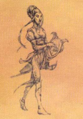 Warsinger, Starter Set:Model Description Booklet (2001), p22. Art by Sam Wood.
 -
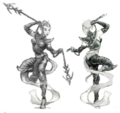 Snakestrike Duelist, art by Sam Wood (2001).
 -
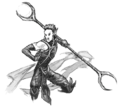 Lajatang Duelist, art by Sam Wood (2001).


External Links
- Thread on Ravilla at Paizo.com; accessed 30 Mar 2021.
References
Citations
- ↑ a b Chainmail Miniatures Game Starter Set (2001), p.9, Rulebook.
- ↑ a b Chainmail Miniatures Game Starter Set (2001), p.20, Model Description Booklet.
- ↑ a b c Dragon #A1 (Annual #1 1996), p.72.
- ↑ a b c d e Ghostwind Campaign (2002), p.10.
- ↑ a b Chainmail Miniatures Game Starter Set (2001), p.22, Model Description Booklet.
- ↑ "The Empire of Ravilla." Dragon#285. p93
- ↑ Chainmail Miniatures Game Starter Set (2001), p.21, Model Description Booklet.
- ↑ 3rd ed. Monster Manual II, p97
- ↑ 3rd ed. Draconomicon, p160.
- ↑ 4th Ed. Monster Vault: Threats to Nentir Vale, p52
- ↑ 4e Monster Manual, p90
- ↑ Miniatures Workshop - Bladesingers are "mentioned in the Chainmail ESD, but no card or picture exists".
- ↑ "The Empire of Ravilla". Dragon #285 (Jul 2001), p.92.
- ↑ Chainmail Miniatures Game Starter Set (2001), p.19-20, Model Description Booklet.
- ↑ Fire & Ice - Set 3 Guidebook (2002), p.17.
- ↑ Set 5 Stat Cards
- ↑ Chainmail Miniatures Game: Core Rulebook (2002), p.14.
- ↑ Blood & Darkness - Set 2 Guidebook. (2002), p.17.
Bibliography
- Pramas, Chris. Chainmail Miniatures Starter Set: Rulebook. Renton, WA: Wizards of the Coast, 2001.
- -----. Chainmail Miniatures Starter Set: Model Description Booklet. Renton, WA: Wizards of the Coast, 2001.
- -----. Chainmail Miniatures Game: Core Rulebook. Renton, WA: Wizards of the Coast, 2002.
- -----. "The Empire of Ravilla." Dragon #285. Renton, WA: Wizards of the Coast, July 2001.
- -----. "Ahmut's Legion." Dragon #286. Renton, WA: Wizards of the Coast, Aug 2001.
- -----. "The Armies of Thalos." Dragon' #287. Renton, WA: Wizards of the Coast, Sep 2001.
- Pramas, Chris, Rob Heinsoo, et al. Ghostwind Campaign. Renton WA: WotC, 2002.
Encyclopedia Greyhawkania Index
The Encyclopedia Greyhawkania Index (EGI) is based on previous work of Jason Zavoda through '08, continued by numerous other fans. The EGI article has a list of sources, product names, abbreviations, and a link to the full, downloadable index.
| Topic | Type | Description | Product | Page/Card/Image |
|---|