Wemic: Difference between revisions
Abra Saghast (talk | contribs) m Text replacement - "isn't" to "is not" |
Abra Saghast (talk | contribs) Adding category |
||
| Line 92: | Line 92: | ||
[[Category:Creatures]] | [[Category:Creatures]] | ||
[[Category:Humanoids]] | |||
[[Category:Races]] | [[Category:Races]] | ||
Latest revision as of 07:01, 8 October 2024
| Wemic | |
|---|---|
 A wemic as depicted in the 2e Monstrous Manual, illustration by Jeff Butler (1993). | |
| General information | |
| Alignment: | Neutral |
| Type: | Monstrous humanoid |
| First appearance: | Monster Cards Set 3 |
The wemic is a creature with the upper body of a humanoid and the lower body of a lion. Like centaurs, they are considered "tauric" creatures.[1]
Description
Wemics are larger and stronger than humans, standing 6 to 7ft tall and 10 to 12ft long, and weighing 600 to 750lbs.[2][3][4] Their lower, leonine portions are covered in soft golden-brown fur as is their upper body.[5] Their claws are sharp, and they can fight with both claws and weapons at the same time. All six limbs are clawed, though on the forepaws and hands they are retractable. They have keen eyesight, including darkvision, and exceptional hearing. The facial appearance of a wemic is a mixture of human and leonine characteristics around their eyes (golden with vertically slit pupils),[2][3][5][6] ears (high on the head and move like cat's[2]), nose (russet or black), and sharp, pointed teeth, as well.

Males grow long mane-like hair.[5][4][3] Wemics are very particular about grooming, and males in particular are very careful about their appearance. Their manes are "combed, braided, dyed, and even decorated with jewelry on special occasions",[2] though their hair is not as course as a lion's mane, being slightly closer in texture to human hair.[2] To insult their mane is a great offense in wemic culture and is cause for a duel. They groom this way as part of courtship, to demonstrate their prowess and suitability as a mate. They are continually sparring, posturing, and parding about. However, it is the females who choose the mate, and polygamy is practiced - though permitted only to leaders.[2]

When a wemic must be still for a time, telling stories around a fire, pausing for a meal, waiting for a friend, or just to take a brief rest, the wemic commonly assumes a posture in which his hindquarters rest on the ground as his front legs remain straight and his forepaws stay flat on the earth. This they call sitting. This is different from a wemic sprawling (both hind and forequarters on the ground, but with torso upright) or laying down.
A wemic can leap up to 50 feet with a running start.
Amongst themselves, wemics speak their own language (a type of Sylvan in 3e[3][4]). Additionally, some wemics who hire themselves out as guides and trackers or have other contact with outside cultures speak (a highly accented version of) the "common" language.[6][7][3][4]
Society
Wemics are incredibly loyal and honest to a fault. Though this is a strong cultural trait, it's possible this may stem from the fact that their tails are as expressive as a cat or lion's tail. Their tails can give away their moods, so there is little point in trying to hide them. They will always honor promises or oaths,

Wemics are excellent hunters and fighters. While wemics are often represented as barbaric, illiterate, and uncivilized creatures, they are quite intelligent and make stone weapons and tools, as well as clay pottery.[8] They are famous for being highly superstitious. Others would describe wemics as nature-oriented people with a rich tradition of oral history.[5]
They live close to the earth, in tune with its magical forces,[5] and in harmony with the nearby populations.[4]</ref> Wemics will even make deals with most others to guide them around or through their lands. But, while they hold few opinions about other cultures, they are extremely careful not to over-hunt their herds and became enraged when humanoids hunt animals for a small part of its body, such as a horn or other trophy, then leave the carcass for carrion.[9] Ironically, the claws of wemics were prized as decorations by bullywugs.[10]
The nomadic wemics will form a series of isolated campsites along their seasonal migratory paths. They will hunt the nearby herds for a given amount of time before rotating to the next camp, allowing others to use the temporary settlements in their absence.[11]
Some wemics live solitary lives and shepherd flocks of sheep and other livestock through rolling pastures.[10] Others will hire themselves out as mercenaries, trackers, or wilderness guides, often seeking magical weapons as compensation for their services.[6][3]
Much like many many humanoid species, wemics can mate any time of the year.[6] Female wemics carry their young for 10 months before giving birth.[6] When born cubs are the size of a normal lion cub or human newborn and have a black-spotted camouflage pattern in their fur for the first two months of their lives.[6]
The females tend the younger cubs. The males of a pride stand guard over their kin at night while they sleep, protecting them from nocturnal dangers.[4][12] So, when they aren't looking over the young, females spend the days scouting or hunting while the males sleep.
Cubs remain with the rest of the pride until they are three[6] to five years old[4], at which point they reach maturity[6] and go on their first hunt. Once they brought back their first kill, they were considered an adult.[4] Older wemics who were too old to hunt, will either remain within their camp, crafting and maintaining weapons and armor,[12] or wander off to the nearest humanoid settlement for a new life, so that they would not slow down their kin.[4]
Homelands
Wemics are native to Hepmonaland and, though rare, can be found throughout the Kabrevo Plain. They are notably in and around Byanbo, Ikelan, Kundanol, Kundaxa.[13]
Prides
Wemics are a nomadic species who do not make settled homes but form patriarchal prides[2], following the herds they hunt for food.[6][14][11] The leader of a pride is always the strongest male.[15][4] Sometimes, a number of prides will band together to form a single tribe, led by a chieftain.[6][3]This has more to do with maintaining good relations between prides than merging them. During times of imminent danger or external threat, a few prides may unite into a nation.[6] A "king" is chosen among the chieftains of the prides who will rule over the greater collective. This congregation has happened only rarely in history.[8]
Prides in proximity to each other often fight over resources like land, game, and water. There is no resentment between then, though, and this is considered normal, with the males enjoying the engagements.[15]
Within wemic prides, the females typically outnumber the males three-to-one.[3]

Religion
Wemics are a superstitious lot. They do not practice "religion" as such, but they are highly attuned to nature which pervades most aspects of their lives. The world is supernatural to them, and they believe in a sort of animism in which everything is alive and magical. Clearly supernatural beings and the undead are a cause of fear in most wemics. Witch doctors and shaman (most often as druids) are the spiritual leaders of a wemic pride.[16] They are important in wemic culture because wemics have no other spellcasters and do not typically practice magic.[16] In wemic culture, they care very little for arcane arts, preferring physical traits they accomplish from their own power.[16]
Diet
Wemics are generally carnivorous[2] but serve meat with stewed roots, grasses and berries.[8] They particularly enjoy wild pig, lamb, and porcupine.[10] Wemics also use salt to preserve meat, and are fond of hot spices.[2]
Alcoholic beverages are favored amongst the wemic and they are known to drink liquors of other cultures.[16] There is no cultural taboo about consuming alcohol amongst the wemic and during celebrations it is not uncommon for all members of the tribe (including cubs) to become extremely intoxicated.[16]
Combat
Wemics can fight with both pairs of claws and wield weapons at the same time. They are known as excellent hunters and fighters who make their own weapons from stone and wood.[3] Any metal or magical armament are typically looted from monsters or creatures they killed.[8]
Trivia
The hair of wemics is used in the creation of brooms of animated attack.[10]
Creative origins
David C. Sutherland III, the artist who painted the covers of the first edition Monster Manual and Dungeon Master's Guide, created the modern-day wemic for a game product called Monster Cards Set 3, a first edition Dungeons and Dragons supplement released in 1982. Though there is no explicit link with Sutherland's creation, the wemic physically resembles an ancient Assyrian mythological protective spirit called an urmaḫlullû.
Gallery
-
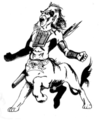 Monster Manual 2 1e, illustrated by Jim Holloway (1983).
 -
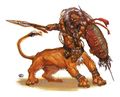 Races of Faerûn, p150. Art by Mike Dutton (2003).
 -
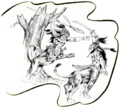 Two wemics engaging in combat, shown in "Ecology of the Wemic". Illustration by Schwartz (1990).


References
Citations
- ↑ Savage Species, p.132.
- ↑ a b c d e f g h i "Ecology of the Wemic", Dragon magazine, p48.
- ↑ a b c d e f g h i Monsters of Faerûn, p84.
- ↑ a b c d e f g h i j Races of Faerûn, p150.
- ↑ a b c d e Races of Faerûn, p149.
- ↑ a b c d e f g h i j k Monstrous Manual 2e, p357
- ↑ Complete Book of Humanoids, pp60-61
- ↑ a b c d Elminster's Ecologies: The Stonelands and the Goblin Marches, p.31.
- ↑ Races of Faerûn, p151.
- ↑ a b c d Elminster's Ecologies: The Settled Lands, p.30.
- ↑ a b "Wemic Camp" web enhancement, p.2.
- ↑ a b "Wemic Camp" web enhancement, p.5.
- ↑ Scarlet Brotherhood, p48-49, 51, 57, 59.
- ↑ Monster Manual 1e, p126
- ↑ a b "Ecology of the Wemic", Dragon magazine, p49.
- ↑ a b c d e "Ecology of the Wemic", Dragon magazine, p50.
| This page uses Creative Commons Licensed content from Wikipedia (view authors). |
Bibliography
- Conners, William, et al. Monstrous Compendium Forgotten Realms Appendix (TSR, 1989).
- Eckelberry, David, Rich Redman, Jennifer Clark Wilkes. Savage Species. "Tauric Creature Template". Renton WA, WotC. Feb 2003. 0-7869-2648-1
- Keeping, JF. "The Ecology of the Wemic." Dragon #157. TSR, 1990.
- Slavicsek, Bill. The Complete Book of Humanoids. TSR, 1993.
- Wyatt, James and Rob Heinsoo. Monstrous Compendium: Monsters of Faerun (Wizards of the Coast, 2001).
- Cayzle. "The Father of Modern Wemics: Personal correspondence with former TSR employees confirming role of David C. Sutherland III in creating wemics for Dungeons and Dragons" (Cayzle's Wemic Site, 2005).
Encyclopedia Greyhawkania Index
The Encyclopedia Greyhawkania Index (EGI) is based on previous work of Jason Zavoda through '08, continued by numerous other fans. The EGI article has a list of sources, product names, abbreviations, and a link to the full, downloadable index.
| Topic | Type | Description | Product | Page/Card/Image
|
|---|---|---|---|---|
| Wemic | Monster | AD&D Monster Cards, Set 3 | Not Numbered | |
| Wemic | Monster | Monster Manual 2, AD&D 1e | 126 | |
| Wemic | Monster | PHBR10 - The Complete Book of Humanoids | 9, 60-61, 88, 94, 115, 116, 117, 118, 119, 120 |