Aquatic elf
 | The article may have broken links, images, citations, or use information imported from other wikis not relevant to GH. Please help clean it up if you are able. |
| This article was proposed for deletion on Wikipedia but was rescued through Deletionpedia—a repository of pages unnecessarily deleted from Wikipedia.. Please edit this page to conform to this wiki's Writing Guidelines and Manual of Style, and to correct template errors before removing this notice. |
| Aquatic elf | |
|---|---|
 A sea elf depicted in Monsters of the Multivers, art by Nikki Dawes (2021). | |
| General information | |
| Size: | Medium |
| Alignment: | Usually Chaotic Good |
| Type: | Humanoid |
| Subtype: | Elf |
| Patron deity: | Deep Sashelas[1][2][3] |
| First appearance: | Monster Manual 1e (1977) |
Aquatic elves (also called sea elves)[4] are water-breathing cousins to land-dwelling elves.[5]
Description
Other than variation in coloration, perhaps the most unique feature of aquatic elven physiology is what allows them to breathe water—they have gills. Their gills are "along their collarbones and down their ribcages."[3]
Sea elves' skintone generally ranges between light blue and dark green.[3], but is most often pale silver-green.[6][7][8] Some sea elves have deep green skin, mottled and striped with brown,[5] while still others have blue skin[6] with white stripes and patches.[5] All these groups are robust and tall with long limbs.[5] Their thick skin gives them protection from the cold of deep water, keeping them comfortable at temperatures just above freezing. Their fingers and toes are generally about twice as long as a human's and have thick webbing between them.[9]
Aquatic elves tend to have "oddly colored"[3] eyes, ranging from an iridescent blue to gold to a white-silver hue that shines like mother-of-pearl.[3] But, they can have eye colors including turquoise,[10] white, black, blue, green, and rarely silver.[11] Their hair is usually thick and somewhat stringy,[5] and some aquatic elves have a rough hair texture.[10]
Sea elves' hair has been recorded as many different colors. It can be green or blue-green,[6][8] Other sea elves have black hair[3], emerald green,[5] silver, or even occasionally red.[5] Warriors clip their hair short, but other aquatic elves wear it long and flowing.[5] Females in particular sometimes grow their hair up to 4 feet long.[12]
Compared to other elves, aquatic elves have deep voices[8] and are larger and heavier.[13][14]
Aquatic elves either go lightly clad or wear no clothes at all. Their clothes are formed from underwater plants[5] and made with intricate designs in shades of black, brown, and green.[12]
Personality
Aquatic elves are isolationist by both their nature and the physical location of their settlements, although they are not quite as reclusive as the wild elves (Grugach). Their trust does not extend far beyond their clan and others of their kind, and their communities are very tightly-knit. They couldn't understand why the surface elves do not realize that community and alliances meant survival, whereas rivalry, individualism, and factionalism meant death.[5] However, despite being extremely cautious, they are also extremely curious, and aquatic elves near the shore will often spend a significant amount time secretly observing the land-bound races.[5]
Abilities
Aquatic elves are the least magical of the elven subraces and have fewer innate magical gifts. However, they are deeply in touch with their environment, even more so than other elves. They can detect minute changes in the currents of the water and can hear sounds underwater that surface dwellers cannot perceive.[8] Additionally, their eyesight is much keener than that of surface races. They can see twice as far as surface elves in low-light conditions (therefore, four times as far as a human)[7] and can see clearly enough to count soldiers in an army up to a mile away.[12] They are able to hide in kelp and seaweed as their surface kin can in forests, and their movement is never hindered when moving through the plants.[12][15]
Due to their gills, aquatic elves are amphibious. The amount of time aquatic elves can leave the water without doing harm to themselves seems to vary. The safe period can be a few minutes,[12] hours,[5][16] a day,[10] or even upwards of a week.[6]} Additionally, the result of going beyond these limits varies. Some will begin to "drown" on land,[5] while others simply experienced a loss of vitality due to drying out and can remain on land indefinitely, remaining healthy if they took the time to soak for an hour every day.[10] Even within the same community, the amount of time can be variable, with some "landwalkers" having a greater capacity for breathing air.[5] Some seem to have no limitation on their time away from water at all.[17][18] Some aquatic elves use clerical magic to allow them to remain on the surface for longer periods of time.[19] Additionally, some aquatic elves are uncomfortable breathing freshwater and became fatigued quickly when doing so.[5] Others are not harmed by it, but will not truly recover from the damage of being above water unless they spent time in salt water.[6]
Society

Settlements
Aquatic elves generally build settlements in calm waters that support coral reefs or seaweed forests.[12][15][3] Sea elven cities are made of living coral and are decorated with mother-of-pearl and bright, polished shells.[3] Settlement borders and the community hunters are protected by armed soldiers, as are their nearby fields of cultivated crop plants.[3] They subsist on kelp grown on their farms and fish they hunt. These settlements usually have populations between 100 and 400, though communities both significantly larger and smaller exist.
Aquatic elven communities are self-sufficient, trading with others rarely and then only for luxuries. Wandering heralds will deliver oral messages between communities.[12][8] Aquatic elves generally spend around 75% of their time within shallow waters which are less than 150 feet from the surface,[20] although they can safely descend to around 600 feet.[21]
Culture
Aquatic elven society is based on family and clan.[3] Noble families and monarchs rule, but in a benign and loose fashion rather than with an iron fist.[3][5] "Nobility" in aquatic elven culture is different from it is in land-based cultures. Most clans have been "noble" at some point; the only requirement for a noble clan is to have another clan swear fealty to it.[3] While women can and do have positions of power, aquatic elven society is largely patriarchal and inheritance runs first through the eldest son.[5]
The concept of private property, for the most part, does not exist among aquatic elves.[5] Whatever given aquatic elf currently carries on their person can be considered theirs, but everything else belongs to the community as a whole.[8] This particularly applies to tools, weapons, and other practical items. Any aquatic elf can take one of these items whenever it is needed, regardless of who has possessed it previously, although individuals are allowed to keep relatively private dwellings. Such communal ownership means theft is almost unknown.[5] The exceptions to this are monarchs, who often have large and elaborate homes with limited access and many personal items. However, aquatic elven rulers are a reflection of their people and usually remain rather generous.[8] The freedom to borrow items at will is not extended to outsiders, and surface-dwellers are often watched carefully to make sure they do not try to take advantage of the cultural practice.[5]
Aquatic elves hold promises sacred and would rather die than fail to complete something they have sworn to do. If they die in the process, their kin take over the responsibility to complete it. The slightest implication that an aquatic elf wouldn't keep their word is deeply offensive. However, promises received from non-elves are highly suspect, both because aquatic elves know other races won't honor the promises of their dead and because only other elves have the lifespan to complete any serious task.[12]
Language
The aquatic elves have their own language that, while clearly related to standard Elvish, is very distinct and not immediately understandable to non-aquatic elves. It is very similar to the language of dolphins, with squeals and clicks interspersed through it. In some editions, the language of sea elves is described as being as an "oddly accented"[22] Elven, with some words and inflections from Aquan.[22] They speak surface languages with great difficulty.[8] Different languages are more or less common among different groups of aquatic elves, but Elven[15][8] and Aquan[17][5] are known by many groups, as is the Common tongue among those who lived near the shore.[12][5] The languages of other aquatic races (including that of their mortal enemy the sahuagin)[12][3] might also be known to an aquatic elf.[10] Nobles and most of those who leave their home settlements to adventure are literate, although commoners are not.[5]
Magic
Aquatic elves are the least magical of the elven races. Once every two or three generations an aquatic elf shows a talent for arcane magic,[19] making magical talent about as common as it is in dwarf communities rather than in human or elven ones.[5] Those who are spellcasters devoted their long life spans to study and become extremely skilled.[5] In remote communities those elves who are magically inclined are limited to the teachings of the few older magic users and rare written materials.
While it is unclear why arcane magic is so uncommon among the aquatic elves, it is rumored that the drow are somehow responsible for taking this ability from them,[12] and this is part of the reason the aquatic elves held such a grudge against them.[23] A minority of the aquatic elves in the areas around Evermeet are sun or moon elves who have been transformed by some power into aquatic elves. They retained the magical capability they have before their transformation.<ref name="DHotR-p5">[24]
Religion
Clerical magic is much more common among aquatic elves.[19] Almost all sea elves revere Deep Sashelas,[3][5] the elven sea god of knowledge and creation, beyond any other. Corellon Larethian is still revered as the father of their race and they acknowledge the rest of the Seldarine to a much lesser extent. It is considered a great honor for a member of an aquatic elven family to be a priest of Deep Sashelas.[19]
Sea elves generally form their temples to Deep Sashelas from living coral. Others are often natural stone and other materials formed into sprawling temples shaped like sea shells. These temples are cultural centers for the aquatic elves, serving both secular and spiritual purposes.[25]
It is a cultural tradition of sea elven culture for adult sea elves at some point in their lifetime to engage in an endeavor for the benefit of the temple where their adulthood celebration was held. This varies from creating art or sculpture for the temple to personal labor at the temple. This tradition is less about what the temple needs and more about the elf giving a gift.[3]
Trishina, a dolphin goddess and the primary consort of Deep Sashelas, is also worshiped by aquatic elves.[26] The relationship between these two gods is one of the reasons aquatic elves are on such good terms with dolphins.[27] Some aquatic elves are also known to worship the water primordial Istishia.[28]
Arts, Crafting & Leisure
Sculpture is the primary art form of aquatic elves, as other mediums are likely to be destroyed by the water in short order. Intricately carved reliefs cover the walls of most cities, and statues are common.[8]
Aquatic elves are also quite musical. Their powerful voices travel farther underwater than on land, and their thrumming songs bring to mind whalesong and dolphin noises. The songs are often very long and evoke the rolling calm of the ocean.[8] Bards are common in aquatic elven society.[5]
Because they live underwater, the products of aquatic elven crafting often differ significantly from their counterparts on the surface. They developed a range of waterproof magical items, and a system of writing underwater using either cured sharkskin or thick seaweed and an extremely viscous ink.[5] They do not commonly use metal, as it is almost impossible to forge underwater and will corrode quickly.[15][5][10] What little metal they do use is traded for or scavenged from shipwrecks. The exception to this is gold, which will not corrode and is easily shaped in its raw form. Beaten gold jewelry is common among aquatic elves. Most aquatic elven items are crafted from stone, coral, shells, and animal materials such as bone, narwhal horns, turtle shells, sharkskin, or chitin.[5]
Aquatic elves commonly craft tridents of serenity, a type of magical weapon which keeps sahuagin in the vicinity of the weapon from entering a blood frenzy and are given to elves patrolling the borders of a territory.[5] They also developed longbows with bowstrings made of a special kelp that damped vibrations and turbulence. Combined with specially crafted arrows, these bows functioned without the usual drastic loss of momentum that most ranged weapons suffered underwater. Chitinous armor is commonly used,[29] Some sea elves developed a type of armor made with sharkskin and teeth, but most aquatic elves despise sharks and find the idea of wearing their skins repugnant.[30]
Relations
May communities of sea elves are isolationistic.[31] shunning all contact with other cultures, especially land-dwelling ones. Aquatic elves hate sahuagin and sharks more than any other creature and will often attack them on sight.[6] They are driven to destroy them at every opportunity.[12][5] Aquatic elven societies are occasionally infiltrated by a certain type of mutated sahuagin that looked almost exactly like them, known as a malenti.[12] Interestingly, normal sahuagin only spawn malenti when they live in close proximity to aquatic elven communities. Tritons believe this is because the two races are related, the sahuagin having been created by drow experiments upon aquatic elven captives.[32] The elves flatly deny this shared origin, and in fact many believe malenti do not exist, at all.[12]
They are also incredibly wary of human fisherman since aquatic elves who are caught in their nets are often mistaken for sahuagin and killed.[12][15][5] Aquatic elves maintain neutral relations with merfolk and locathah. Tritons and marine storm giants sometimes live in harmony with aquatic elven settlements.[10]
Aquatic half-elves are very rare since aquatic elves cannot easily leave the water often and have little interest in interacting with humans.[33][34] Additionally, the ability of aquatic half-elves to breathe underwater is variable,[33] and as such even those few that do exist are often cut off from sea elven culture. However, a few aquatic elves remained invested in their children's lives, and will visit them when they came out onto the water.[34] Aquatic elves also sometimes reproduce with surface elves (generally sun or moon elves), which resulted in an elf who looked like the subrace of their surface parent except for the greenish tinge to their hair. Unlike aquatic half-elves or even their full blood parents, all such offspring are fully amphibious, having gills that are hidden on their necks but being able to comfortably breathe air indefinitely. As such, they are fully capable of living among their aquatic kin, and those whose mothers are aquatic elves often did.[12]
Aquatic elves will sometimes take in water genasi children to raise, although in general the genasi secretly pitied the elves for not being able to leave the water for long periods. Water genasi who serve Deep Sashelas sometimes work as emissaries between aquatic elves and their surface cousins. Aquatic elves have stories of planetouched aquatic elves (similar to water genasi) descended from servants of Deep Sashelas, but there have been no recent examples of such people.[35]
The creatures aquatic elves have the closest relationship with are dolphins.[12][15][5][10] Any large group of aquatic elves have a 50% chance of being accompanied by a number of dolphins.[12] They held whales in great reverence as well, with many of their settlements being built on whale migration routes so that they can interact with the creatures regularly. Young aquatic elves will even travel with a whale pod for a year as a sort of pilgrimage.[5] Hippocampi and giant sea horses are the favored mounts of aquatic elves.[36] Many other marine creatures are also tamed as mounts, beasts of burden, and pets.[10]
History
According to one aquatic elven myth, they once dwelled on land, their ancestors having served as an armada that was going down in a storm and was saved by an unknown goddess.[8]
Notable Aquatic Elves
See Also
Gallery
-
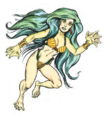 Monstrous Manual 2e
 -
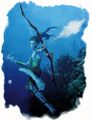 Stormwrack 3e
 -
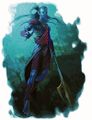 Stormwrack 3e
 -
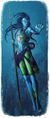 Stormwrack 3e


Appearances
External Links
References
Notes
Citations
- ↑ DMGR4 Monster Mythology (1992), p.87.
- ↑ Monster Manual (Oct 2000), p.102-103.
- ↑ a b c d e f g h i j k l m n o Stormwrack, p.39.
- ↑ PHBR8 The Complete Book of Elves (1992), p.13.
- ↑ a b c d e f g h i j k l m n o p q r s t u v w x y z aa ab ac ad ae af ag ah ai Races of Faerûn, p.28-30.
- ↑ a b c d e f PHBR8 The Complete Book of Elves (1992), p.14.
- ↑ a b Monster Manual v3.5 (2003), p.102-103.
- ↑ a b c d e f g h i j k l The Elves of Evermeet, p.26-29.
- ↑ Demihumans of the Realms, p.61.
- ↑ a b c d e f g h i "Children of the Deep". Dragon #116 (Dec 1986), p.28-30.
- ↑ Cormanthyr: Empire of the Elves, p.19.
- ↑ a b c d e f g h i j k l m n o p q r Monstrous Manual (1993), p.110-111.
- ↑ Races of Faerun, p.28.
- ↑ Races of Faerun, p.61.
- ↑ a b c d e f Monster Manual (1977), p.39.
- ↑ The Elves of Evermeet, p.105.
- ↑ a b Mordenkainen's Tome of Foes (2018), p.62-63.
- ↑ Mordenkainen Presents: Monsters of the Multiverse (2021), p.30.
- ↑ a b c d Cormanthyr: Empire of the Elves, p.94-96.
- ↑ Sea of Fallen Stars, p.38.
- ↑ Sea of Fallen Stars, p.183.
- ↑ a b Stormwrack, p.40.
- ↑ Tangled Webs (1998), p.228.
- ↑ Demihumans of the Realms, p.5.
- ↑ Demihuman Deities (1998), p.105-106.
- ↑ DMGR4 Monster Mythology (1992), p.94.
- ↑ Sea of Fallen Stars, p.60.
- ↑ Nightwatch In The Living City, p.9.
- ↑ Races of Faerun, p.157.
- ↑ Races of Faerun, p.158.
- ↑ Monstous Manual, p.11.
- ↑ Monstrous Manual (1993), p.307.
- ↑ a b Sea of Fallen Stars, p.77.
- ↑ a b Races of Faerun, p.60-61.
- ↑ Races of Faerun, p.128-129.
- ↑ Demihumans of the Realms, p.63.
Bibliography
| This page uses Creative Commons Licensed content from Aquatic elf on the Forgotten Realms Wiki (view authors. |
Encyclopedia Greyhawkania Index
The Encyclopedia Greyhawkania Index (EGI) is based on previous work of Jason Zavoda through '08, continued by numerous other fans. The EGI article has a list of sources, product names, abbreviations, and a link to the full, downloadable index.
| Topic | Type | Description | Product | Page/Card/Image
|
|---|---|---|---|---|
| Aquatic Elf | Monster | Reference | SEE Elf, Aquatic | |
| Elf, Aquatic | Monster | Native of: Material Plane, | Dragon magazine #295 | 96 |
| Elf, Aquatic | Monster | Native of: Material Plane, | Dragon magazine #350 | 65 |
| Elf, Aquatic | Monster | Native of: Material Plane, | Ghosts of Saltmarsh, D&D 5e | 38, 52, 58, 61, 82, 111, 134, 246 |
| Elf, Aquatic | Monster | Native of: Material Plane, | Ivid the Undying | 51, 53, 93 |
| Elf, Aquatic | Monster | Native of: Material Plane, | Living Greyhawk, Living Onnwal Gazetteer, D&D 3.5e | 85, 103 |
| Elf, Aquatic | Monster | Native of: Material Plane, | MC11 - Forgotten Realms Appendix 2 | Insert (Elf, Aquatic) |
| Elf, Aquatic | Monster | Native of: Material Plane, | Monster Manual 1, AD&D 1e | 39 |
| Elf, Aquatic | Monster | Native of: Material Plane, | Monstrous Manual, AD&D 2e | 110-111 |
| Elf, Aquatic | Monster | Native of: Material Plane, | Monstrous Manual, AD&D 2e (Premium Edition) | 110-111 |
| Elf, Aquatic | Monster | Native of: Material Plane, | Monster Manual 1, D&D 3.5e | 103 |
| Elf, Aquatic | Monster | Native of: Material Plane, | Monster Manual 1, D&D 3.5e (Premium Edition) | 103 |
| Elf, Aquatic | Monster | Native of: Material Plane, | Monster Manual 1, D&D 3.0e | 86 |
| Elf, Aquatic | Monster | Native of: Material Plane, | PHBR8 - The Complete Book of Elves | 10, 12, 13-15, 33, 37, 63, 78 |
| Elf, Aquatic | Monster | Native of: Material Plane, | Stormwrack, D&D 3.5e | 34, 39, 40, 148-150, 215, 216 |
| Elf, Aquatic | Monster | Native of: Material Plane, | The Kopru Ruins, D&D 3.5e | 1, 2, 3, 10 |
| Elf, Aquatic | Monster | Native of: Material Plane, | U1 The Sinister Secret of Saltmarsh | 16, 18, 23, 24, 27, 29 |
| Manaan Tribe (Aquatic Elf) | People Group | Clan, | U1 The Sinister Secret of Saltmarsh | 24 |
| Oceanus | Non-player character | Male, Elf, Aquatic, [F3/T3], | Ghosts of Saltmarsh, D&D 5e | 38, 56, 58, 59, 61, 65, 72, 73, 82, 111, 246 |
| Oceanus | Non-player character | Male, Elf, Aquatic, [F3/T3], | U1 The Sinister Secret of Saltmarsh | 24, 25, 29 |
| Oceanus | Non-player character | Male, Elf, Aquatic, [F3/T3], | U2 Danger at Dunwater | 2, 4-6, 13, 20, 22, 29 |
| Oceanus | Non-player character | Male, Elf, Aquatic, [F3/T3], | U3 The Final Enemy | 3, 5, 6, 11, 12, 20, 22, 29, 38 |