Felldrake
| Felldrake | |
|---|---|
 A Crested Felldrake, as appearing in Dragon #285 (2001), art by Sam Wood. | |
| General information | |
| Alignment: | Usually Good |
| Type: | Dragon |
| Subtype: | Lesser |
| First appearance: | Dragon #285 |
Felldrakes are a type of usually wingless lesser dragon predominantly found in Ravilla in Western Oerik.
Description
These small dragons are incredibly varied;[1] there are at least seven distinct species of felldrakes detailed in various sources. They are a created species, but were later bred and enhanced to have various forms and abilities.[2][note 1] In Greyhawk, Bahamut and a "group of powerful elven archmages" created the felldrakes to serve the elves of Ravilla.[1][3][4][5][6]
Many, even most, domesticated felldrakes are used for military purposes, but other drakes are used for the purposes of performing other services and serve as "guards, hunting companions, military animals, mounts, messengers, and even beasts of burden".[7] Some are kept as pets.[7][8]
They are inherently an integral a part of society in Ravilla and are part and parcel to the culture, prolifically found in the roles of various domestic animals existing in other cultures. Apart from military units, it is truly unknown just how omnipresent they are, but lore indicates felldrakes don't replace mammals as domesticates, but instead are also considered domesticated beasts and exist beside them.[8][note 2] The one thing never indicated in lore is being livestock.
Felldrakes are a type of creature, and they are as varied as the elves they are known for living alongside. While all felldrakes are drakes, not all drakes are felldrakes.
But, there are a few unifying generalizations which can be used to identify the distinct traits of most all felldrakes—
- All have a fanged mouth, clawed digits, and a serpentine tail.[7][8]
- All have four legs, and most are quadrupeds, though some have shorter forelimbs and walk more upright.
- Most have bright, decorative crests, a great deal of horns or spikes, or vibrantly colored scales.
- They are social creatures, and many cooperate like wolves in packs.
- They do not have wings and are flightless[1][3] (some drakes have wings, felldrakes do not).
- They do not have breath weapons, though one known species spits acid.
- Felldrakes (who are all descendants of Bahamut) all have good alignments,[1][6] though not all drakes do (including those created by the Cult of the Dragon).
- There are both wild and domestic felldrakes. Some are caught or trapped like other wild animals to be trained.[8][9] It is common for felldrakes to wander the land.
- They have animal- or beast-level intelligence and are not capable of speech.[10][11][12][note 3]
- In Ravilla (and in various editions), after the first felldrakes were made by Bahamut and elven archmages, there is breeding of felldrakes much like that done with horses or dogs.[2] Some are bred for duties like acting as guards or bloodhounds.
- In editions which use game-term distinctions, felldrakes are classified as "dragon", "drake", "dragonkind", or "dragonblood". Similarly, they are a "subtype" of "drakes", much as red dragons are a subtype of True Dragons, and much as wyverns are a "type" of dragon, or a draconic creature. They are also a "natural beast".[9]
A crested felldrake's "bright orange crest runs from skull to tail, and it shifts in color from light orange to deep red as the felldrake closes in on its prey and smells its fear."[2]
Felldrake Subspecies
There are many different varieties of felldrakes. Some were altered in many ways by the powerful mages who created them, and others are simply bred into their specialty. Crested, Guard, and Tri-horn felldrakes are known specifically to be bred. Apart from fifth edition drakes created by the evil Cult of the Dragon, felldrakes do not adhere to the categorization of True Dragons by the color of their scales.
Several types of felldrakes have been in more than one edition and have been variously known as both "felldrakes" and simply "drakes". For example, horned drakes and horned felldrakes are depicted as being the same, as are spitting drakes and spitting felldrakes. Those felldrakes which are also called drakes are often depicted simultaneously with previously unpublished drakes, implying the terms are interchangeable in some instances.[14] In some sources, "felldrake" seems to be used for enhanced, bred, domesticated creatures, and "drakes" are described as being wild.[9]
| Felldrakes | Drakes |
|---|---|
|
|
Felldrakes have a high degree of genetic diversity and speciation. The various subspecies or varieties of felldrakes vary widely in size. Though the majority of felldrakes are "medium" or "small" sized, there are some rare few as big as a horse ("large"), specifically the spiked felldrake which can be used as a mount. The most common felldrake in Ravillan society, the crested felldrake,[1][4] is the size of most dogs ("small").
Breeding
Crested felldrakes (also known as crested drakes) were bred from guard drake stock.[2] Though, in artwork, the crested felldrake is depicted nearly identically to the guard drake, being green-scaled and having a yellow crest (see artwork below), confusing the distinction between the two. The exception to this depiction coming in fifth edition, when guard drakes are depicted as quadrupeds, while they had previously been shown to not use their (shorter) forelimbs for walking.
There are wild, domesticated,[2] and trained felldrakes.[9] There are also breeding programs for them.[2]
Prior to fifth edition D&D, felldrakes are noted as able to be bred, but in fifth edition, it is specifically noted that "a drake can't reproduce."[7] It is possible this refers only to the chromatic drakes present in the Tyranny of Dragons storyline. Those are created by a "ritual, which takes several days, requires 10 pounds of fresh dragon scales (donated by the dragon allied with the group), a large amount of fresh meat, and an iron cauldron. When the process is complete, a halfling-sized egg emerges from the cauldron and is ready to hatch within a few hours."[7][10] This seems similar in theme to the creation of felldrakes in earlier sources. However, while it is noted the Cult of the Dragon creates guard drakes, they are not the only ones—it is also done by "other groups that are skilled in arcana and associated with dragons."[15]
One distinction between felldrakes and the drakes presented in fifth edition is the participants of the ritual. The dragons involved in the creation of the chromatic drakes in Tyranny of Dragons were evil mortal dragons associated with the Cult of the Dragon. The creation of felldrakes of Ravilla had the involvement of a deity in the ritual, Bahamut, who is a metallic dragon deity (rather than an average chromatic dragon) made it so the felldrakes of Ravilla are a true species, rather than remaining simply created creatures. While correlation does not equal causation, in the officially published examples we see felldrakes created by Bahamut and the ancient archmagi of Ravilla are able to breed, while guard drakes created by the Cult of the Dragon are not.
Personality
Most felldrakes have the reputation of being surly, aggressive, or difficult to manage. However, this applies mostly to wild felldrakes or those found in military use. While a separate stat block for a calm, peaceful felldrake is not ever given, lore specifically states some of them are pets and some are domesticated.[2]
Abilities
Each subspecies of felldrake has different strengths and weaknesses. Some are smarter than others, though they are not intelligent enough for language or speech. They "communicate using chirps, whistles, growls, and roars."[7][10][11][12][note 3]
Some felldrakes can manage to accomplish using "their handlike claws to manipulate objects",[7] even to "open or close doors."[2]
Activities
Aside from the services and activity for which they are trained, some felldrakes have particular behavior for which they're known.
For example: Horned drakes spend the day sleeping in the sun, preferring to hunt at night or in the early hours of morning.
Society

In nature, some felldrakes have "nests".[7] It is unknown whether this is true of felldrake pets, or of military felldrakes. It can be presumed domesticated felldrakes still have the same nesting instincts as wild ones.
A group of felldrakes is referred to as a "clutch".[7][2][9]
Felldrakes, by nature, are social creatures, congregating with other felldrakes,[16] with some types even belonging to the same clutch.[17] They are pack hunters,[2]
After the Demon War, felldrakes became an integrated part of Ravillan society. They cooperate with the Ravillan elves and comprise a notable and significant part in Ravillan society, being used in that society as "guards, hunting companions, military animals, mounts, messengers, and even beasts of burden".[7] Some are kept as pets.[7][8]
Relationships
Some mighty knights or paladins employ spiked felldrakes as mounts.[6] There are also rangers known as Drakewardens who share a particular bond with a drake (similar to a ranger's normal Animal Companion). The drake grows and matures eventually serving as a mount and gaining the ability to fly.[18]
Notable felldrakes

While the vast majority of felldrakes are unnamed, one notable felldrake is found well outside of Ravilla.
Gut Tugger (NE rog2) is the unusually intelligent crested felldrake companion of Rowyn Kellani (female human rog3/brd2), encountered in the Savage Tide adventure path.[19] Gut Tugger was originally from Ravilla, but had a "bitter, surly", violent disposition with a strong "mean streak"—his alignment is very atypically neutral evil. When his trainers attempted to put him down, he killed them and fled, only to be captured by animal smugglers. He is more than intelligent enough to have "played the role of a mindless creature, knowing that this was a free ticket to somewhere far from his elven oppressors" and eventually ended up in Sasserine. Heldrath Kellani purchased Gut Tugger as a gift for her daughter, Rowyn, the guildmaster of the Lotus Dragons rogues' guild. They "formed a fast friendship, and he took to her lessons in thievery with shocking ease." Gut Tugger has a surprising intelligence of 10, allowing him to take class levels (Rog2).
History
Felldrakes have existed in Ravilla for over a millennium. Bahamut led dragons to end the Demon War, c.-420 CY (1006 years after the Demon War, by Sundered Empire reckoning), and joined with a "group of powerful elven archmages" to create the felldrakes to serve the elves of Ravilla.[1].
Publishing history
Third edition
Felldrakes have appeared in numerous sources over various editions. Their first appearance was as a miniature (crested felldrake) in the Chainmail Miniatures Game (2001), sculpted by Paul Muller. They are given D&D stats in Dragon magazine #285 by Chainmail Miniatures Game Creative Director, Chris Pramas.[1] The statistics are later repeated in the Set 2 Guidebook: Blood & Darkness (2002) with only minor differences—they gain the scent ability, their bite attack is raised from 1d6 to 1d8, and they gain one point of Strength.
Fourth edition
Felldrakes are given identical descriptions, but their names are identified as "drakes" instead of "felldrakes" in the fourth edition Monster Manual (2008). While it is accurate that all felldrakes are still drakes, this resulted in blurring the line distinguishing the two. Particularly, the guard drake and spitting drake are identical to the crested and spitting felldrakes of third edition. Similarly, in the Monster Manual II (2009), the horned felldrake is depicted identically in both art and stats, alongside other, newer drakes. The guard and spitting drakes' stats are repeated in the Monster Vault (2010). Finally, in Monster Vault: Threats to Nentir Vale (2011), they are once again named felldrakes, and the crested felldrake was depicted, as well as new felldrakes: the leaping, hissing, and tri-horned felldrakes.
Fifth edition
In Volo's Guide to Monsters and in Hoard of the Dragon Queen, the Cult of the Dragon creates guard drakes once again, and again they are depicted as almost entirely the same as felldrakes of the same name. The main difference being they walk on all four feet instead of having shorter forelimbs and being bipedal. They were described as unable to breed, unlike their progenitors.
See Also
See also Ravilla
Gallery
-
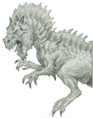 Crested felldrake,
Dragon#285, art by Sam Wood. -
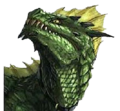 Crested felldrake, Dungeon #139, "There is No Honor". Art by Ben Wooten.
 -
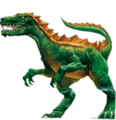 Crested/Guard drake,
4e Monster Manual, art by Zoltan Boros & Gaborszikazai. -
 Crested felldrake (Gut Tugger) and Rowyn, Dungeon #139, art by Ben Wooten.
 -
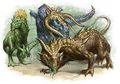 Crested, horned, and spitting felldrakes,
3e Monster Manual II, art by Sam Wood. -
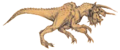 Horned felldrake,
Model Description Booklet, art by Sam Wood. -
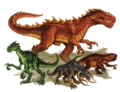 Horned drake (with scytheclaw, fang titan, and bloodseeker drakes).
4e Monster Manual II, art by Jim Nelson -
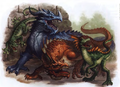 Leaping, tri-horn, hissing, and crested felldrakes,
4e Monster Vault: Threats to the Nentir Vale, art by Jim Nelson -
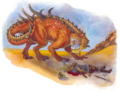 Spiked felldrake,
3e Draconomicon, art by Emily Fiegenschuh. -
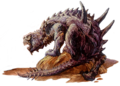 Spiked Felldarake, Chainmail Miniatures Core Rulebook, art by Jeff Easley
 -
 Spitting felldrake,
Fire & Ice Set 3 Guidebook, stat card, Spitting felldrake, art by Sam Wood. -
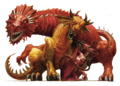 Spitting drakes (with rage drake and pseudodragon).
4e Monster Vault, art by Zoltan Boros & Gaborszikazai -
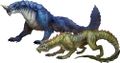 Guard drakes (5e), Monsters of the Multiverse.
 -
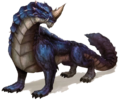 Guard drake (5e), Tyranny of Dragons: Horde of the Dragon Queen
 -
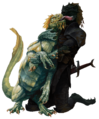 "Drakewarden". 'Fizban's Treasury of Dragons, Ch1.


References
Notes
- ↑ "Common drakes enhanced by [their creators]..." who "altered the drakes in various ways and bound them to service."—Threats to Nentir Vale (2011)
- ↑ "They’re similar to domesticated mammals..." and "Drakes are more expensive than other domesticated beasts".
- ↑ a b Some early examples of felldrakes did not agree with each other in third edition's earliest days. In some isolated stat blocks, before felldrakes' stats were made uniform, some felldrakes were given "Dragon traits",[3] which included a minimum of INT 6, but that was amended in all later 3e sources. In later editions, they are given Intelligence of 2 to 4. In fifth edition, all drakes have INT 4, but can "understand [language] but can’t speak".[13] Although, a drake "might attempt to communicate by growling, chirping, roaring, purring, or hissing"[12] or "whistles"[7]
Citations
- ↑ a b c d e f g "The Empire of Ravilla". Dragon #285 (Jul 2001), p.93.
- ↑ a b c d e f g h i j Monster Vault:Threat to the Nentir Vale (2011), p.52.
- ↑ a b c Monster Manual II (Sep 2002), p.97.
- ↑ a b Chainmail Miniatures Game Starter Set (2001), p.24, Miniatures Description Booklet.
- ↑ Chainmail Miniatures Game Starter Set (2001), p.21, Miniatures Description Booklet.
- ↑ a b c Draconomicon (2003), p.160.
- ↑ a b c d e f g h i j k l Monster Manual (2008), p.90.
- ↑ a b c d e Monster Vault (2010), p.82.
- ↑ a b c d e Monster Manual 2 (2009), p.88.
- ↑ a b c 5e Volo's Guide to Monsters, p158
- ↑ a b Monster Manual III (Aug 2004), p.130.
- ↑ a b c Monster Vault (2010), p.84.
- ↑ Volo's Guide to Monsers (2016) , p.158.
- ↑ Monster Manual 2 (2009), p.89.
- ↑ Mordenkainen Presents: Monsters of the Multiverse (2021), p.151.
- ↑ Monster Manual (2008), p.92.
- ↑ Demonomicon3e, p.160.
- ↑ Fizban's Treasury of Dragons, p.15-16.
- ↑ "There is No Honor". Dungeon #139 (Oct 2006), p.42-43 , by James Jacobs.
Bibliography
- Bonny, Ed, Jeff Grubb, Rich Redman and Skip Williams. Monster Manual II. Renton, WA: Wizards of the Coast, 2002. Item code 88268.
- Burlew, Rich, Eric Cagle, Jesse Decker, et al. Monster Manual III. Renton, WA: Wizards of the Coast, 2004. Item code 17921. ISBN 0-7869-3430-1
- Crawford, Jeremy, lead designer. Adam Lee, Mike Mearls, Christopher Perkins, et al. Mordenkainen Presents: Monsters of the Multiverse. Renton, WA: Wizards of the Coast, 2022. ISBN 978-0-7869-6787-2
- Findley, Nigel. FOR1 Draconomicon. Renton, WA: TSR, 1999. Item code TSR9297.
- Heinsoo, Rob and Stephen Schubert. Monster Manual 2. Renton, WA: Wizards of the Coast, 2009. Item code 23966.
- Hershey, Sterling, Brian R. James, Matt James and Steve Townshend. Monster Vault: Threats to the Nentir Vale. Renton, WA: Wizards of the Coast, 2011. Item code 28364.
- Mearls, Mike, Stephen Schubert and James Wyatt. Monster Manual. Renton, WA: Wizards of the Coast, 2008. Item code 21720.
- Mearls, Mike. Volo's Guide to Monsters. Renton, WA: Wizards of the Coast, 2016. Item code B8670.
- Pramas, Chris. Chainmail Miniatures Starter Set: Rulebook. Renton, WA: Wizards of the Coast, 2001.
- ———. Chainmail Miniatures Starter Set: Model Description Booklet. Renton, WA: Wizards of the Coast, 2002.
- ———. Chainmail Miniatures Game: Core Rulebook. Renton, WA: Wizards of the Coast, 2002.
- ———. "The Empire of Ravilla." Dragon #285. Renton, WA: Wizards of the Coast, July 2001.
- Thompson, Rodney, Logan Bonner and Matthew Sernett. Monster Vault. Renton, WA: Wizards of the Coast, 2010. Item code 24465.
- Wyatt, James. (lead designer) Fizban's Treasury of Dragons. Renton, WA: WotC, 2021. ISBN 978-0-7869-6729-2
Encyclopedia Greyhawkania Index
The Encyclopedia Greyhawkania Index (EGI) is based on previous work of Jason Zavoda through '08, continued by numerous other fans. The EGI article has a list of sources, product names, abbreviations, and a link to the full, downloadable index.
| Topic | Type | Description | Product | Page/Card/Image
|
|---|---|---|---|---|
| Felldrake | Monster | Dragon; Native of: Material Plane | Monster Manual 2, D&D 3.0e | 97 |
| Felldrake | Monster | Dragon; Native of: Material Plane | Dragon magazine #285 | 93 |
| Felldrake | Monster | Dragon; Native of: Material Plane | Monster Vault: Threats to Nentir Vale, D&D 3.5e | 52 |
| Felldrake | Monster | Dragon; Native of: Material Plane | Chainmail Miniatures: Starter Set, Miniature Description Booklet (2001) | 21, 24 |
| Felldrake | Monster | Dragon; Native of: Material Plane | Draconomicon 3e | 160 |
| Felldrake | Monster | Dragon; Native of: Material Plane | Monster Manual, D&D 4e | 90, 92 |
| Felldrake | Monster | Dragon; Native of: Material Plane | Monster Vault, D&D 4e | 82, 92 |
| Felldrake | Monster | Dragon; Native of: Material Plane | Volo's Guide to Monsters, D&D 5e | 158 |
| Felldrake | Monster | Dragon; Native of: Material Plane | Monster Manual 2, D&D 4e | 88 |
| Felldrake | Monster | Dragon; Native of: Material Plane | Monster Manual 3, D&D 3.5e | 130 |
| Felldrake | Monster | Dragon; Native of: Material Plane | Dungeon magazine #139 | 42, 43 |