Manscorpion
| Manscorpion | |
|---|---|
 A manscorpion appearing the Monstrous Compendium, vol.1 (1989), art by Mark Nelson. | |
| General information | |
| Size: | Large |
| Alignment: | Usually neutral evil |
| Type: | Monstrosity |
Manscorpions are also called scorpion folk,[1] scorpionmen, and stingers,[2] but their "proper" name is tlincalli.[1][3] They are terrifying monstrous humanoids with the lower bodies of giant scorpions found in the Bright Desert, created by the Curse of Shattados.[3][4][5]
Description
The upper part of a manscorpion is the upper body of a human. The lower part of the manscorpions's body is of a eight-legged giant scorpion.[note 1] Plates of armor made from bone cover the body from the upper abdomen down. Manscorpions are completely hairless. Their hands are not dexterous, as they have two large fingers and a thumb.[3] Their human-like facial features are handsome—except for their segmented, insect-like eyes—and exude calm.
Ecology
Tlincallis are obligate carnivores and consume any meat they can find, either freshly killed or carrion left behind by another predator, and are not above cannibalism.[4] They are not hunted by other predators.[3]
Tlincallis lay their eggs in a dark, warm nest, usually surrounded by cacti. The eggs have firm shells on which a paralytic poison coating is found. When the eggs are about to hatch, tlincallis tie captives in the nests. Upon hatching, the young fed on the hapless victims.[1]

The poisonous coating of a manscorpion's bony armor is sought after by alchemists, who extract it and use it as a component.[1]
Personality
Abilities
Tlincalli spellcasters use divine spells. They can detect the vibrations of a walking creature up to 60ft away (tremorsense).
Society
Tlincalli lived in tribes, some settling and founding cities and some nomadic.[1] Dwarves and humans are often captured by tlincalli. They are use as slave labor in tlincalli mines and smithies. Nomadic tribes are scavengers, stealing what they required from their victims.[1]
Tlincalli culture is philosophical and sophisticated, if a bit difficult for most other peoples to understand. For example, they would perform complex divination rituals in which groups of males and females would use their tremorsense from underground to map out arbitrary grids on the surface, and then lie in wait for days as they studied the patterns of living creatures moving through the grid and connecting ostensibly mystical locations. Based on the results of their seemingly random observations, they might launch an attack or decide how to treat the next stranger they met, always with absolute confidence in their actions.[6]
An even more bizarre tradition is one in which tlincallis would sometimes engage in what appeared to be sudden and inexplicable mass suicide. These events are called "stinger races" by observers, and featured groups of up to twenty tlincallis—almost entirely males—who would leave their nests and just run as fast they can—stopping for nothing but to defend themselves from attack—until they all dropped dead.[6]
Religion
Originally, before the Curse of Shattados changed them, the rulers of Sulm had turned to "forbidden magic and the worship of evil gods"[7] and even Shattados himself had Tharizdun as a patron.[8] After the apotheosis of the citizens, their worship is not specified.
Language
Tlincali have their own language, spoken by no other known species or culture.[3] It is the "corrupt remnants of their ancient language" (ancient Flan—the language spoken in ancient Sulm).[4] There is only one known speaker of the original language—Shemaya (Wiz19), a powerful 2,000-year-old wizard, and the only known human survivor of the Curse of Shattados who escaped it in a time bubble.[9]
Possessions
Activities
Relationships
History
Manscorpions were created by the Curse of Shattados. When the sorcerer-king of Sulm, Shattados donned the Scorpion Crown, he was transformed into an immense monarch scorpion—even larger than other monarchs or even giant scorpions. At the same time, all those who followed Shattados, or owed him allegiance in any way, were transformed into manscorpions.[10]
Rumors and legends

Creative origins
The first version of the manscorpion appeared in White Dwarf #16 (1979) in an ongoing column called The Fiend Factory (Don Turnbul, ed.), and were created by Phillip Masters.[11]
Publication history
Trivia
When a tlincalli is use in heraldic designs, it represented "alertness and treachery".[12]
Combat
Tlincallis are organized warriors. As they frequently patrolled their territory, squadrons of six to eight warriors are most often encountered by other creatures. The leader of the squadron is also the only spellcaster in the group. The favored weapons of tlincallis are bolas and macas.
A standard tlincalli tactic is to engage an opponent from afar, using their bolas or other ranged weapons. Afterwards, they charged and surrounded their target, engaging in fierce melee combat. In addition to using a maca, they use their sharp claws and strong tail to knock opponents off their feet. The stinger at the end of their tails delivered a fatal venom. Additionally, their bony armor is covered in poison.[1]
Another favored tactic is to engage an enemy from below (or if fighting underground, occasionally from above). They possessed a supernatural ability to drive their bodies straight through solid earth, suffering minor injuries in the process but granting them the ability to strike swiftly and without warning from unexpected directions.
Both female and male tlincallis are trained and skilled in combat.[6] A scholarly treatise on tlincallis is found in Tym's Monstrous Book. It contained a detailed analysis of the ecology of tlincallis.[13]
Gallery
-
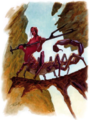 By Alan Pollack, Monsters of Faerûn (2001).

External links
Disclaimer:Any lore presented through the following links does not necessarily adhere to established officially published content, and the views expressed do not necessarily represent the views of the editors of this wiki.
References
Notes
- ↑ The 1st edition source depicts manscorpions with four legs, 2nd-edition sources state that a tlincalli has six legs, while images in 3rd, and 5th-edition sources show them with eight legs.
Citations
- ↑ a b c d e f g Volo's Guide to Monsters (2016), p.193.
- ↑ Monster Compendium: Monsters of Faerûn (2001), p.80.
- ↑ a b c d e Monstrous Manual (1993), p.245.
- ↑ a b c WGR3 Rary the Traitor (1992), s.v. Manscorpion.
- ↑ Living Greyhawk Journal #21 (Dungeon #98/Polyhedron #157, May 2003), p.22.
- ↑ a b c Monster Compendium: Monsters of Faerûn (2001), p.81.
- ↑ WGR3 Rary the Traitor (1992), p.15.
- ↑ Living Greyhawk Journal #21 (Dungeon #98/Polyhedron #157, May 2003), p.23.
- ↑ Living Greyhawk Journal #22 (Dungeon #103/Polyhedron #162, Oct 2003), p.75.
- ↑ WGR3 Rary the Traitor (1992), p.133.
- ↑ White Dwarf (1979) , p.18.
- ↑ "Fantastic Heraldry". Dragon #199 (Nov 1993), p.46.
- ↑ Pages from the Mages, p.117.
Bibliography
Encyclopedia Greyhawkania Index
The Encyclopedia Greyhawkania Index (EGI) is based on previous work of Jason Zavoda through '08, continued by numerous other fans. The EGI article has a list of sources, product names, abbreviations, and a link to the full, downloadable index.
| Topic | Type | Description | Product | Page/Card/Image
|
|---|---|---|---|---|
| Manscorpion {Tlincalli} | Monster | MC11 - Forgotten Realms Appendix 2 | Insert (Tlincalli) | |
| Manscorpion {Tlincalli} | Monster | Monstrous Manual, AD&D 2e | 245 | |
| Manscorpion {Tlincalli} | Monster | Monstrous Manual, AD&D 2e (Premium Edition) | 245 | |
| Manscorpion {Tlincalli} | Monster | White Dwarf #016 | 18 | |
| Manscorpion {Tlincalli} | Monster | WGR3 Rary the Traitor | 62 |